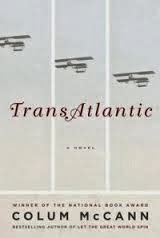
Colum McCann opened his award-winning novel Let the Great World Spin with a dramatic, real-world event — Philippe Petit's 1974 high-wire walk between the newly built Twin Towers of New York. In similar vein he opens TransAtlantic with another astonishing feat — the first nonstop transatlantic flight by the British airmen Alcock and Brown shortly after the end of World War 1.
In both novels, these daring acts demonstrate man's relentless desire to challenge and push through the boundaries of what is possible. They also serve as narrative anchors for a McCann's multi-stranded narrative about individuals whose lives overlap and connect during some 150 years of American-Irish history.
McCann brings together three real-life stories: Alcock and Brown and their ground-breaking flight; a visit to to Ireland in 1845 by the antislavery activist Frederick Douglass and the diplomatic attempts by Senator George Mitchell to broker the 1998 Good Friday peace settlement in Northern Ireland. The novel's final strand introduces four generations of women whose fictitious lives intersect with those of the real-life characters over the centuries. Via these multiple narratives we go back in time to an Ireland on the verge of famine and to the American Civil War and then come forwards to the 1998 Good Friday Agreement and the demise of the Celtic Tiger.
It's an ambitious approach structurally and thematically. McCann's story is essentially about the complex connections between two nations separated but yet united by the same stretch of water. Into this he weaves ideas about the way ordinary lives are touched by great moments in history.
Given the scope and scale of his ambition, he could perhaps be forgiven a few misses. TransAtlantic begins on a strong note with the recreation of Alcock and Brown's flight through snow and fog aided only by some rudimentary navigation systems.
Three thousand feet above the sea. In the cloud their balance is shot to hell. No sense of up. No down. Two thousand five hundred. Two thousand. The slap of rain and wind in their faces. The machine shudders. ... Their bodies are thrown back against the seats. What they need is a line of sky or sea. A visual. But there is nothing but thick, grey cloud... No horizon, no centre, no edge.
The next few sections sadly don't live up to that opening promise. The 1845 famine caused by the failure of the potato crop is sketched slimly while the chapters set during the American Civil War are dealt with so slightly they don't have much impact. For me the weakest strand came with the efforts to bring about some form of lasting settlement between the British government and the paramilitary forces in North Ireland. Diplomacy by its nature doesn't lend itself that well to the dramatic but the portrayal of Senator George Mitchell sucks even more life from the narrative. We get no strong insight into his character beyond the fact he is tired of the painfully slow progress of talks and would much rather be at home with his family instead of criss-crossing the ocean.
Nor are these middle sections helped by McCann's terse prose which often contains verbless sentences or one-sentence paragraphs where the words come forth like a machine gun.
You might be tempted during these sections to give up on the book.
I urge you to resist the temptation.
McCann has saved his best for the final chapters.
This is where he switches to the remaining female members of his fiction family. The particular focus is on Hannah Carson, the great grand-daughter of a young maid who was so inspired by hearing Douglass talk of freedom and equality, that she crossed the Atlantic to make a new life for herself in America. Her descendants eventually returned to the motherland.
Now aged 72, Hannah lives in the family's tumbledown cottage on the shores of a tidal lake with only her incontinent dog for company. She feels not only the pressure from a bank that demands she sells so she can clear her overdraft, but also the weight of her country's history and its traumatic effect on her own family. It's quite the most powerful and moving part of the whole novel.
Originally posted at www.bookertalk.com

