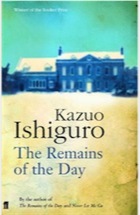
Showing posts with label 1989 - The Remains of the Day. Show all posts

Monday, April 23, 2012

Athena K's Review - The Remains of the Day


This is my first Kazuo Ishiguro novel. I was expecting to really enjoy it - and it surpassed my wildest expectations. In this tale of the tragedy of servitude, what Ishiguro does not write is even more powerful than what he does. His adept use of languge and deep subtelty paint a rich, beautiful, and in many ways timeless tragedy - and it was wonderful.


In Remains of the Day, Stevens, a middle aged butler at a well-to-do English country mansion is given several days off by his new employer.  He decideds to take a trip, both physically and metaphorically, as he muses about the great events of his life over the course of his travels.  At first, Stevens' musings seem mundane, trite, and perhaps even boring.  But Stevens' explanation of his dedication to his job and absolute loyalty to his master, his self-sacrifice and his definitions of what make a butler great began to appear to describe something much larger - and the ways in which I started to compare his story to the tragic figure of a samaurai warrior were fascinating to me.  The parallelism between English butlers and Japanese samaurai, or really any servant class in an honor culture, was so rich that I am still wanting to read commentary and consider all of the angles days later.

Stevens' tragedy is, ultimately, that the man for whom he sacrificed his life - his family, his friendships, his individuality, and his chance at love, seems not to have been worthy of such a sacrifice. This soft, lingering tragedy is as heartbreaking as it is beautifully written, and I would highly recommend this to everyone.

Thursday, April 8, 2010

Lorraine's Review - The Remains of the Day

Many of us have seen the Merchant -Ivory movie adaptation of The Remains of the Day (1993) where Anthony Hopkins and Emma Thompson play the leads. Hopkins is firmly tattooed for me as Stevens, the butler of a great English house - Darlington Hall. He has spent his entire adult life in the first half of the 20th century in the absolute and complete service of Lord Darlington. He has tried his utmost to strive to be the greatest butler he can be (all the while knowing that he is not among the “greats”) and to do everything he possibly could for the Lord. His repression of his entire personality and feelings is paramount to him as his only concerns are the orderly efficiency and operations of the house. He thinks that his work as a butler is his life’s purpose but it is at the expense of his emotional life. Thompson played Miss Kenton, the head of housekeeping, and she often butted heads with Stevens and brought him the only sparks of feistiness and an opportunity for love.


The novel begins with a prologue in 1956. The house has recently come under the control of an American, Mr. Farraday. Stevens is baffled by him and by his desire to banter with him. Farraday offers Stevens the use of his car so that he can go on a driving holiday and the butler takes him up on it so he can go and visit Miss Kenton, now Mrs. Benn. She has hinted in a letter to Stevens that she has left her husband and might want to return to the house. The journey sparks memories for Stevens. He feels that he has contributed to world events as so many prominent Europeans and British leaders met at the house to discuss important matters like the possible appeasement of Germany. Lord Darlington was engaged in a futile attempt to negotiate with the Germans before WW2. All of his efforts fail and he is vilified in the press. Stevens always puts all matters of the house first and ignores his dying father upstairs when these important visitors need him downstairs. His stoic repression is something he perceives as “dignity” and he is proud of his place in the scheme of English society. Because of his rigid nature Stevens misses all the cues for love with Miss Kenton and cannot open himself up for any opportunities for a relationship with her or even his dying father.


The car journey allows Stevens a chance to ruminate upon his life and he finally evaluates whether he has done the right thing or not. One incident is particularly telling as he relates dispassionately the time when the Lord had him fire two Jewish workers. Miss Kenton vigorously defends the two workers but is unable to carry out her threat of leaving based on her principles. He keeps on teasing her about when she is going to leave and she finally tells him that she has no family or other support in life.

At the end of the journey he meets Mrs. Benn for a short interlude at the end of the day. As they are both nearing the ends of their lives – the evening time is an apt metaphor and one which recurs in the novel. The film version ends quite differently with the motif of a bird symbolically flying in the great house. I liked the quiet “end of journey” motif in the novel where Stevens promises himself that he will work on his bantering skills with Mr. Farraday when he returns from his trip. This resolution is true to the very core of Stevens’ persona and outlook and also speaks to the challenges of another day for him.


At first I found the way Stevens speaks to the reader to be very stiff and pretentious. But I soon realized that his character is a mirror reflecting all of the major events and themes of the 20th century – the Great Wars; anti Semitism; the decline of the upper class in Britain; the ascendancy of America after the war as exemplified by the change in ownership of the house; the rise of Realpolitik; and the changing relationships with women and in the workplace and much more. Stevens becomes a fascinating character who illuminates the first half of the century through his observations and gives us a chance to reflect upon the decisions which rule our own lives.

Monday, March 2, 2009

Laura's Review - The Remains of the Day

The Remains of the Day
Kazuo Ishiguro
245 pages

It is sometimes said that butlers only truly exist in England. Other countries, whatever title is actually used, have only manservants. I tend to believe this is true. Continentals are unable to be butlers because they are as a breed incapable of emotional restraint which only the English race are capable of. (p. 43)


Thus does Stevens, a butler on a fine English estate, describe the dignity and restraint he sees as essential elements of the truly great butlers -- a title he will not allow himself to claim, although it is probably deserved. Stevens spent 30 years in service at Darlington Hall, beginning in the 1920s. He did all his master asked of him, with complete decorum and the much-admired restraint. He was assisted by a housekeeper, Miss Kenton, who left after many years to marry and have a family of her own. The novel begins with Stevens taking a rare holiday, a trip across the country to visit Miss Kenton. A recent letter from her led him to believe she would be interested in returning to service at Darlington Hall. The letter resurrected memories and emotions; long suppressed in the interest of dignity and restraint. During Stevens' journey, he relives his years serving Lord Darlington, and his relationship with Miss Kenton.

The story is told entirely in Stevens' voice. Ishiguro has a way of making the situation perfectly plain to the reader, even though much is left unsaid. The reader sees a side of Lord Darlington that Stevens himself was unable to acknowledge. And his feelings for Miss Kenton are crystal clear, even though they never break through his reserved exterior. I nearly cried when he and Miss Kenton parted company the first time, and their reunion was heavily laden with missed opportunity and dashed hopes that once again were quite moving.

I was worried that this book would be spoiled by having seen the film many years ago. And while I couldn't help envisioning Stevens just as he was portrayed by Anthony Hopkins, I still found myself immersed in this book as if experiencing the story for the first time. Wonderful, emotional, reading. ( )

My original review can be found here.

Saturday, January 24, 2009

Monday, November 17, 2008

The Remains of the Day by Kazuo Ishiguro (Jill)

The Remains of the Day
By Kazuo Ishiguro
Completed November 13, 2008


The Remains of the Day is a perfect example of a character-driven story. It’s the narrative of Stevens, an English butler who took a road trip when his American employer was on holiday. While you read about Stevens’ traveling adventures, you learn more about Stevens’ career as a butler to Lord Darlington, a prominent English diplomat who had ties to the Nazis before the war.

Stevens’ entire career was devoted to serving his employer in a dignified fashion. His ultimate goal was to make his employer’s life easier so his employer could focus on being a “good” person. As Stevens recounted his career with Lord Darlington, he reflected on his employer’s decisions. Always faithful, he maintained a blind loyalty to Lord Darlington – even when situations indicated the man’s flaws. The reader can see where Stevens struggled to maintain his loyalty. However, he always sided with Lord Darlington– for if Lord Darlington wasn’t the best man he could be, than Stevens was a failure as his butler.

While on his road trip, Stevens hoped to meet a former housekeeper, Miss Kenton, to ask her to return to Darlington Hall. She worked with Stevens during its heyday, and they shared a very unusual relationship. At times, I felt that they were attracted to each other, and then other times, I thought they lived to annoy each other. It was a nice tango that moved the storyline at an interesting pace.

Admittedly, I was a little thrown off by Kazuo Ishiguro’s writing style at the beginning. Stevens initially came through as stuffy and detailed, but after 25 pages, I settled into this story. The Remains of the Day offered a compelling look into the life of an English servant and his struggle to maintain his dignity while his employer’s life shattered. His pursuit of Miss Kenton illustrated his desire to put things as they were (an impossible task). Smart and intriguing with excellent character development, I would highly recommend this Booker Prize winner to anyone who enjoys good literary fiction. ( )

Wednesday, April 23, 2008

Trevor's Review of Ishiguro's The Remains of the Day

"You've got to enjoy yourself. The evening's the best part of the day. You've done your day's work. Now you can put your feet up and enjoy it."

One of my favorites, not just of the Booker winners but of all books. Ishiguro's writing is subtle. Somehow he can get us to feel and understand so much from a narrator who says so little and who avoids acknowledging his own feelings. Stephens is one of my favorite characters in all of literature despite the fact that he is only a butler of a great house. He holds so much emotion even though he won't let it out, as is shown when he carries on his duties despite the decline of his father whom he regards as the perfect example of a butler. However, he cannot constantly keep his feelings inside, and even though he might not understand why he feels the way he does, readers can and can then sympathize with him even when feeling frustrated at his demeanor.

The book begins with Stevens, now an old man, traveling across England to meet up with an old friend, the housekeeper during the home's glory days between the wars, when important men from all over the world met to discuss international affairs. While driving across the country, Stevens thinks back on this time with pride, yet he also feels shame. These conflicting emotions confuse him, and he can never quiet reconcile them. He is proud of his work maintaining the house; only now, looking back, he realizes that his service might not have been as important or as moral as he thought. And almost worse, the home now does not require a great staff. It no longer is important to international affairs, and is more notorious for its suspect past than respected for its greatness. Stevens is now entering the evening of his life, and he approaches this time with immense trepidation. In a way, he is seeking his old housekeeper both as an attempt to bring the wonderful period between the wards back to the present and as an attempt to atone for his indirect involvement in the affairs of the home.

Ishiguro's ability to write about large themes (in this book we see pacifism, bigotry, class structure, duty, and most importantly life, death, and love) without addressing them directly or becoming didactic is what makes him one of the best writers out there today. I have been slightly disappointed after reading his two latest: When We Were Orphans and Never Let Me Go (but even those two were masterfully written and were shortlisted). He still has my complete attention simply because he wrote The Remains of the Day.