Showing posts with label 2012 - Shortlist. Show all posts

Wednesday, September 25, 2013

2012 Shortlist The Lighthouse by Alison Moore


Alison Moore's debut novel The Lighthouse is a quietly deceptive tale; one of those books that so gently wraps itself around you that you just have to keep reading even when you're not really sure where it's going.

This is not a novel that bursts forth with a big bang opening or one that contains any significant dramatic events. Instead we follow the slow trail of a middle-aged man bearing the oddly-sounding name of Futh, as he takes a solo walking holiday in the Rhineland.  Futh's idea of a good holiday is rather simple; he isn't looking for adventure but rather a 'week of good sausages and deep sleep'  that will help him recover from the recent break up of his marriage. We soon discover that his marital separation isn't anywhere as traumatic an experience as his mother's decision to abandon him as a child.

Futh is a lonely and rather hapless soul. A man who seems only half complete. He has no true friends; his father mocks his work as chemist who creates fake scents for polishes and air fresheners and his marriage is little more than a relationship of convenience.  As he tramps the paths along the Rhine each day with blistered feet and sunburnt head he recalls episodes and fragments from his life.

Futh clings to his past life with the aid of a small lighthouse-shaped perfume bottle that once belonged to his mother. He carries it with him everywhere, a talisman whose  violet scent always reminds him of his mother and the last day they enjoyed together before she abandoned him.

This small object, one of many motifs within the novel, takes on additional significance in the second strand of the book in which we meet the owners of a small hotel/bar called Hellhaus (German for ‘lighthouse’) where Futh begins and is due to end his holiday. Esther has a habit of enticing some of her male guests to sleep with her as a way of getting her taciturn husband Bernard to show an interest in her again. He does with the aid of dark threats and a heavy fist.  Poor Futh gets caught up in their tangled lives on his first night on holiday when he attracts Bernard's mistaken suspicions of an assignation with Esther. Futh leaves the establishment on the first morning blissfully unaware of the smouldering fuse he is leaving behind in this hotel and to which he will return. Although this is not a suspense novel in the traditional sense, Moore's narrative gradually notches up the tension with each step that takes Futh back to the hotel.

The Lighthouse explores the consequences of a traumatic incident in childhood; the way the past impacts the adult self.  Futh evokes our sympathy for the hopelessness and emptiness of his life and his obsession with the past, with its old wounds and childhood hurts that will always keep dragging him back and prevent him achieving from achieving happiness.

Sunday, January 27, 2013

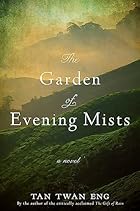
Tony Messenger - 2012 Shortlist - The Garden of Evening Mists - Tan Twan Eng


I must admit, gardening is not really my thing, I do appreciate a beautiful garden and I have seen a number of Japanese gardens in my time, obviously without fully appreciating the abstract message being conveyed. This novel is a contemplative one, hence the week or so since I finished it before getting to this review. It was a slow read, only due to the fact that I was letting it slowly sink in, as I’m sure Tan Twan Eng intended.

Set in Malaya in the mountains we have our narrator Yun Ling Teoh returning to the gardens of the evening mist to relive her story of being apprenticed to Nakamura Aritomo, a former gardener of the Emperor of Japan. Judge Teoh is a former war criminals prosecutor who had spent time in a Japanese prisoner of war camp, where her sister perished. She despises the Japanese for those atrocities but at the same time her story of her relationship with Aritomo and her wish of building a garden for her sister’s memory is slowly drip fed to us. Her time working Aritomo’s garden (Yugiri) and her relationship with the gardener and the locals is revealed slowly through the mists of her recollections.

At each turn in the path, Aritomo drew my attention to an arrangement of rocks, an unusual sculpture, or a stone lantern. They looked as if they had been lying there on the beds of moss and ferns for centuries. ‘These objects signal to the traveller that he is entering another layer of his journey,’ he said. ‘They tell him to stop and gather his thoughts, to savour the view.’

And our story unfolds in this manner, long winding passages with detailed descriptions of leaves, or clouds and then the occasional blooming of Judge Teoh’s story, we as readers have entered another layer of our journey. Although you could simply follow the narrative plot here this is a multi layered novel one that slowly encompasses “the art of setting stones” and a miniature view of a much broader landscape. We do have tea ceremonies, Buddhist references, raked sand to represent various elements, holes in hedges to focus your attention and more. All sub plots to the main story by our  narrator, who is losing her memory but revealing her story to us at the same time. A story which contains local terrorists, tea growers, tribes who harvest bat nests (for soup), kamikaze pilots and a mystery of hidden Japanese war wealth.

Despite my fears of a CT attack, I enjoyed living on my own again, in these mountains where the breath of trees turned to mists, where the mists entered the clouds and fell to earth again as rain, where the rain was absorbed by the roots deep in the earth and drawn out as vapour again by the leaves a hundred feet above the ground. The days here opened from beyond one set of mountains and ended behind another, and I came to think of Yugiri as a place lodged somewhere in a crease between daybreak and sunset.

This is a beautifully styled novel and as I mentioned before one that I allowed to slowly sink into my conscience. Judge Teoh’s life and the journey through war camps, through varied relationships and her attachment to Japanese gardens as well as woodblock prints and tattoo was not a journey I could quickly skim through. Personally I could understand frustration at a number of reader’s hands and if Japanese gardens, meditation and slow awareness is not your thing then this would probably infuriate you no end.

Overall a very enjoyable novel which taught me a great deal about Japanese gardening, post war Malaya as well as narrative style. A worthy inclusion to the Booker Shortlist.

Cross posted at my blog.

Friday, December 21, 2012

Laura's Review - The Garden of Evening Mists

When Yun Ling Teoh retires from her career as an attorney and a judge, she returns to the Malaysian highlands, where she spent the years immediately following World War II. Recently diagnosed with a degenerative memory disease, she wants to record her life's memories before they disappear.

Yun Ling was the only survivor of a Japanese camp; her sister died there. After the war, Yun Ling sought out Aritomo, former gardener to the Japanese emperor, to learn the art of Japanese gardening and create a garden in her sister's memory. Yun Ling is filled with anger at the Japanese, and overcome with guilt over her sister's death. Her time with Aritomo becomes a time of healing and spiritual renewal.

As readers we live in Yun Ling's mind, moving seamlessly between present and past. So seamlessly, in fact, that occasionally I had to back up and re-read pages to ground myself in the correct time period. In the present day, Yun Ling is visited by a man researching Aritomo's life and work. This storyline, combined with Yun Ling's memories of Malaysia during and after the war, convey the brutality of this period in a very powerful and emotional way. But this is not "just" a wartime story. The Garden of Evening Mists is also about beauty and love, and the ability of both to persist through the most horrific circumstances.

I had looked forward to reading this book after it was nominated for the 2012 Booker Prize, and received several rave reviews on LibraryThing. I was expecting a 5-star read, which is probably unfair. The writing was beautiful and poetic, but it wasn't "unputdownable," and I always felt at a slight distance from the characters and the plot. Nevertheless, I recommend this book for those who like quiet, slow-paced, character-driven novels.
 
Cross-posted from my blog

Sunday, November 18, 2012

Tony Messenger - 2012 Shortlist - Narcopolis - Jeet Thayil


To say it has been a mad couple of months would be an understatement, holidays, catching up on the work that piled up whilst I was on holidays, charity work, running and all whilst attempting to be a dad!!! Thank goodness I’ve had a great Booker Prize shortlist to transport me away from the day to day grind, pity I haven’t had time to update my blog. This will be a short review only.

I read this novel about a month ago so please forgive me if my recollections aren’t fresh and straight  onto the page.  This is Indian poet Jeet Thayil’s debut novel and even though it is primarily a novel about drug addiction, it is also a social reflection on the city once known as Bombay (the novel begins and ends with the work “Bombay”).

This novel opens with our mysterious narrator stating, “…and since I’m the one telling it (the story) and you don’t know who I am, let me say that we’ll get to the who of it but not right now”, and moves throughout from first person to third person narrative across numerous characters. The eunuch prostitute and opium den worker Dimple, is the one who seems to appear most, but she is not the narrator. We also have den owner addict and family man Rumi, a celebrated artist who can’t control his addictions, an ageing Chinese refugee who laments on a place and time lost as well as our “narrator” recently returned from the USA.

The common bond being drugs, this is an hallucinatory story about loss of identity, motivations for addiction, peppered with dream like sequences, bold tales of the physical impacts of drugs containing graphic details of violence and sex. Through addiction, each character has lost more than their control of their lives, this is how the raw underbelly of a city existed in the 1970’s.

Only the rich can afford surprise and/or irony. The rich crave meaning. The first thing they ask when faced with eternity, and in fact the last thing, is: excuse me, what does this mean? The poor don’t ask questions, or they don’t ask irrelevant questions. They can’t afford to. All they can afford is laughter and ghosts. Then there are the addicts, the hunger addicts and rage addicts and poverty addicts and power addicts, and the pure addicts who are addicted not to substances but to the oblivion and tenderness that substances engender. An addict, if you don’t mind me saying so, is like a saint. What is a saint but someone who has cut himself off, voluntarily, voluntarily, from the world’s traffic and currency?

There is also the melting pot of religion, race, gender, poverty vs wealth and more in this dark tale, that reflects the seemingly better capitalist world of the future (Mumbai) against the not too distant past, as well as giving voice to the victims of that time. Is the new future life of being clean what the poor and addicted want?

Unlike any other Indian novel I have read before this debut strikingly delves into the city of Bombay and the tales of opium, cocaine and heroin addiction are startlingly real, and I could understand why some readers have found the subject matter, the style (who’s voice is talking now?) and the bleak moral a bit too much to handle. Another realist novel on the 2012 shortlist, looks like we’re living in very very dark times indeed.

Cross posted at my blog.

Wednesday, November 14, 2012

Rachel's Review - 2012 Shortlist The Garden of the Evening Mists

2012 Shortlist: The Garden of the Evening Mists, by Tan Twan Eng

Review
Having suffered through a Japanese slave-camp during WWII, Yun Ling Teoh, a young Chinese-descent lawyer in Malaysia, carries around a lot of anger against the Japanese. However, she'd made a promise to her deceased sister that she would build a Japanese garden, so she reluctantly visits Aritomo - the only Japanese gardener in Malaysia. Aritomo refuses to design a garden for Yun Ling, but he offers to take her on as his apprentice so that she may design one herself. Yun Ling learns to let go of her anger as her friendship with Aritomo grows. But Aritomo has his own secrets. 

How can I express what an amazing book this was? Sure, it had a couple of slowish spots (it WAS, after all, a book about gardening) but the story is magical. The historical and cultural backdrop is intriguing (I learned a lot while reading, but didn't feel like I was being "taught"). Because the book takes place in two different times (current day and shortly after WWII), the story unfolds gracefully - allowing the reader to learn the story of Aritomo and Yun Ling at just the right rate...but yet somehow the time also blends together giving an impression of continuity that is particular to Eastern philosophy. On top of that, the more I learned about the story, the more fascinated I was by the two characters. This book is definitely worth your time. 

Interpretive note with possible spoilers
One thing that struck me while I was reading this book is that I noticed an inconsistency in what the narrator (Yun Ling) was saying. At first, I wasn't sure whether the author had made a mistake or if he had purposely introduced inconsistencies to show that Yun Ling had either an unreliable memory or was hiding something. I finally came to the later conclusion (though the unreliable memory was possible too). I think it's fascinating that such inconsistencies added to the overall effect rather than subtracting from it. I applaud Tan Twan Eng for his careful writing of this book. 

If you're interested in reading more of my reviews, come to my blog!

Sunday, October 14, 2012

Rachel's Review -- 2012 Shortlist Narcopolis


Narcopolis, Written by Jeet Thayil, Narrated by Dean Robertson


2012 Shortlist 


My Review
In this opiate-veiled book, Thayil introduces readers to the seedy underbelly of Bombay. It begins in the 1970's and transitions with surreality into modern-day Mumbai--which has lost not only its tradition and identity, but also it's name. The story follows several memorable characters, all of whom fight addiction in one form or another. Addictions range from opiates to violence to sex to adulation. The most memorable character IMO is Dimple, a pipe-wallah, a prostitute, and an addict. Dimple's character is rather horrifying to the unjaded Westerner because she was abandoned by her mother and sold into prostitution as a child. At the age of 9, she was castrated and her penis was removed, which apparently makes her into a deliciously seedy prostitute (in the eyes of creepy men who make me shudder). When we are introduced to her, she is a little older, and is suffering some of the ill affects of her surgery--including addiction to opium, which was originally given to her as a narcotic for her pain. We watch Dimple as she changes from a beautiful young woman to a sickly and shriveled middle-aged woman. 

Perhaps I'm reading too much in to the story (I think it would be clearer after a second reading, which it's not going to get), but I think Dimple was meant to represent India. When we met Dimple, she was young and beautiful, as was the young India. She had been docked and gelded, yes, but she was beautiful, intelligent, and had potential if ONLY she could get out of her rut. Perhaps this is meant to imply that the Westerners had "docked and gelded" India (by their colonization and then partitioning of the land), but that she still had potential. She was still beautiful. But time passed, and the slow-and-easy opium life in the "best opium den in Bombay...maybe even India," was forcibly supplanted by frightening hallucinatory "cheap" chemical-laced heroin. During this time, Dimple became increasingly sick. Likewise, India itself was getting sicker from the negative influences of modernization. As time passed, Dimple's name changed, as did Bombay's, and their identities were lost in the harsh new world.

This book was allegorically very deep, and I'm sure that a second, third, and fourth reading would teach me something new every time. But, unfortunately, once was enough for me. I don't regret reading the book...it will stay with me forever. But the violence, sex, drugs, and sickening human condition described was enough for me the first time around. Don't get me wrong, all of these negative issues were handled with graceful tact. But it was still difficult for me to read. 

Now, a note on the narration: I imagine this book was a very difficult one to read aloud. Robertson chose to represent surreal quality behind the veil with an airy tone of detachment. This detachment makes the narration less-than-enticing. However, this is not the narrator's fault, but an issue with the book itself. I think a tone of detachment was probably quite appropriate in this situation. Just be warned...if you're picky about narrations, then this book may be better read silently. :) On the other hand, if you're reasonably tolerant, like I am, then you should be able to delve into the story with no problems. Robertson's tone of detachment didn't distract from the story, once I got used to it and understood the purpose. I was happily able to engross myself in the flow. AND a nice? thing about the audiobook is that I apparently missed a 6-paged sentence. I didn't even notice it. ;)

To see more of my reviews see my blog Resistance is Futile

Ali's review: 2012 Shortlist Umbrella Will Self


A brother is as easily forgotten as an umbrella. (James Joyce, Ulysses)
Surely the phrase “it’s worth the struggle” when applied to a book one is about to read is a phrase to strike fear into the heart of any reader. Yet that is one phrase that seemed to come out of several reviews that I read about this Booker shortlisted novel. Irritatingly it might actually be true. I have to say that a modernist, stream of consciousness is not my idea of a literary good time. It is in fact the kind of writing I generally avoid. There were times when reading this novel – that I lost my way a bit – there were moments when I found myself thinking “what the ..” however I didn’t hate it – I actually rather liked it. It is a challenge – and I do think that the novel will carry on dividing opinion – and it may also, I’m afraid, disengage many readers who feel life is just too short.
“Umbrellas are never contracted for, only mysteriously acquired, to be fleetingly useful, then annoying and cumbersome before eventually being lost.”
The story – don’t worry there is a story, and a good one – concerns Dr Zack Busner and his work in the 1970’s with a group of patients at the Friern hospital in London. The patients are those suffering from encephalitis lethargica – contracted around the time of the First World War. One patient in particular interests Busner – Audrey Death. The story of Dr Busner’s work with his trusty side kick psychiatric nurse Mboya is woven into the story of Audrey’s life and that of her two brothers during the First World War. Audrey, a working class girl born in 1890, becomes a feminist and a munitions worker, at the London Arsenal where her bother Albert launches his career, ending up in charge of the place itself. When Audrey contracts the sleeping sickness that swept the world at this time, her brother Stanley is missing, while Albert is coming up in the world. Busner’s relationship with Mboya and his patients is what really engaged me. The world of the huge Victorian asylums that by the 1970s were coming to an end is a horrifying one, the image of catatonic human beings left for decades to merely exist with little if any intervention is one to make anyone shudder. In 2010 an ageing Busner, returns to where the Friern hospital was, to contemplate his work.
“Nostalgia, he thinks, more and more of it will be needed to tranquillise the collective psychosis of a steadily ageing population. And he would have reached for an appropriate Biro were he not having such a bad day.”
The non-linear structure of this novel makes it hard work at times. There are very long sentences – paragraphs which go for pages – no chapters, and the different story strands weave in and out of one another. There are times when decades pass in the middle of a sentence, so the reader really needs to keep their wits about them, and so it is certainly not a quick read.
As regards the Booker Prize, I wouldn’t be surprised to see it win, it wouldn’t be my choice as winner – but it is clever and the prose is really very good. However I don’t think a book that so many people will be put off reading – or that will start and give up on – should win. For me the prize should be about celebrating books that are beautifully written, certainly, but also books that people want to read and engage with, I’m not sure Umbrella is that kind of book.

Monday, October 1, 2012

Ali's review - 2012 shortlist - Narcopolis - Jeet Thayil


“Because now there’s time enough not to hurry, to light the lamp and open the window to the moon and take a moment to dream of a great and broken city, because when the day starts its business I’ll have to stop, these are night-time tales that vanish in the sunlight like vampire dust”
This will be a fairly short review – as I don’t want to spend too much time talking about a book I disliked. I stopped short of hating it – just – but I certainly didn’t like it. The writing is good – in places very good, lovely prose –something I always enjoy – you might expect that at least I suppose in a Booker shortlisted novel, but the subject, the setting and the characters I disliked.
“Then there are the addicts, the hunger addicts, the rage addicts, the poverty addicts , and power addicts, and the pure addicts who are addicted not to substances but to the oblivion and the tenderness the substances engender. An addict, if you don’t mind me saying so, is like a saint. What is a saint but someone who has cut himself off, voluntarily, from the world’s traffic and currency.”
Shuklaji Street, in Old Bombay is the setting, a place of opium addicts, prostitutes and violence. The novel spans many years, starting in the 1970’s with changing narrators it is chaotic and hallucinatory and really rather squalid, upon finishing it I wanted a bath. The narrator of the start of the novel is a visitor to the Opium den of Rashid, where he also meets the eunuch prostitute Dimple, he returns at the end of the novel, many years later to see who is left and find out what has happened to the people he knew back then.
The construction of the novel is more like many small stories that weave in and out of each other in a non-linear way. We meet Mr Lee – a regular patron of Dimple’s whose back story takes us to the cultural revolution of Mao’s china. I did find the stories of Mr Lee and Dimple to be the most interesting, and for a while after struggling with the beginning of the book I began to actually enjoy it. However I found it difficult to remain interested in the characters and the construction of the novel made it hard at times to follow. This construction is very clever – this dream like almost hallucinatory quality is beautifully suited to these stories – the narratives seem like the confused and foggy view of an opium addict might look.
I had looked forward to this book – and judging by the reviews of it on Goodreads and Amazon I am something of a lone voice. Most people seem to have liked it a lot – so I must have missed something, it always rather annoys me if I feel I have missed what others haven’t. Well we can’t always like the same things can we?

Tony Messenger - 2012 Shortlist - Umbrella - Will Self


Where to start? Where to start? At the beginning? An epigram by James Joyce, well that’s the start isn’t it? Gives it away? Probably the easiest part of the book to read. A journey – rugged, with traps and snares galore, across 90 years. NINETY TWO to be exact. Covering Dr Zack Busner’s work with mental patients. More specifically a mental patient called Audrey Death. Death, De’Ath (something like that I can’t remember and can’t find it – how could you when the novel is 397 – THREE HUNDRED AND NINETY SEVEN – pages, PAYYY JEZZZ, long and there are no chapters, only paragraphs that go for 26 pages at a time, well not all of them but more than most. Oops forgot linear structure, no problems this book doesn’t have any, only reason I know it goes for ninety two years is the précis inside the front cover, a nice brown one too, just like the quick brown fox jumping over a lazy dog, no dogs in the war, or were there? Not sure, things can get frightfully muddled in the trenches, especially when your sister is working in an arsenal making the munitions – MOO NISCH ONS – that’s my sister Audrey. Gets encephalitis lethargica you know, that’s a sleeping sickness of the mind. What do you do with people who get that? Put them in a mental hospital of course, with others who have it too. Use an umbrella to keep the rain off, or as an insider’s term for the treatment.

Get the um-brella, Doctor! Get the umbrella! Which is a euphemism he knows to be widespread among the staff, and which he abhors. – Eeeerarrr’rrra’rrra -!

Had to put a quote in – always do – sometimes more than one, probably a good idea to put another one in, why not three short ones, gives the same idea

her brain…it’s outside of time…so far away…in another place… in another phase of development, Willis said when they all pitched up that morning.

told the psychiatrist he had experienced it as a continuous present, an awful and unchanging Now?

He knows – and understands also that using net curtains to guard against your privacy is as futile, surely, as employing tenses to divide time?

Did I mention we follow a Doctor? He treats these patients, tries to find a cure, manages to get a few of them awake, in retrospect of course, there’s no such thing as time in this novel, only give away are the lines from songs thown in every now and then. Sing along songs of WW1 days (World War One, the Great War, the war to end all wars, that one), pop tunes of the 70’s (who’s an ape-man? I’m an ape-man, I’m an ape ape man, I’m a ape-man….oops done it again, opening sentence given away) Italics would be useful, help you break up your thoughts – not that things would stay the same even mid senten

Chop and change, here we go ‘round the mulberry bush…the mulberry bush, could make sense and probably does if you have a repetitive mental illness where time has stood still. Especially working in a repetitive job, working a lathe, or making umbrellas (there they are again – what do they mean?). Have to red this again, can I do it? They’ll be reading this one for years, studying it in universities – YOU – KNEE – VERR – CITY – they will you know. Will win the prize, I’m confident of that, a standout book, one that’s the most challenging of reads, one that will infuriate about 92% of readers (that means 8% will read it right through– you know how it works 100% less the ninety two who didn’t finish it – hey there’s that NINETY TWO number again, could that mean anything?)

Will Self is credited with the following quotes – and as we know quotes from the web are always true -  "I don't write fiction for people to identify with and I don't write a picture of the world they can recognise. I write to astonish people.”,  "What excites me is to disturb the reader's fundamental assumptions. I want to make them feel that certain categories within which they are used to perceiving the world are unstable."  He’s achieved that here – a heroic, challenging but ultimately very rewarding novel, just don’t expect it to be easy. For me the absolute standout of the year’s shortlist of the ones I’ve finished to date.

PS – Just in case there are one or two of the 92% out there, this review is a poorly written parody - PARRROOOOODEEEE

Cross posted at my blog.

Sunday, September 23, 2012

Ali's review - 2012 Shortlist - Swimming Home - Deborah Levy


Swimming Home is the fourth of this year’s Booker shortlist that I have read so far. For me it has the feel of that obscure and hard to describe thing – “A Booker book” – that is not the same thing as being the one I liked best – it’s not.
Swimming Home is quite a slight novel – I read it over one day in a couple of sittings. It is a darkly comic exploration of depression and its consequences.
“When Kitty Finch took her hand off the steering wheel and tod him she loved him, he no longer knew if she was threatening him or having a conversation.”
It is the summer of 1994 and two very middle class families are spending their holiday in a French villa. Poet Joe, his war correspondent wife Isobel, their 14 year old daughter Nina and Isobel’s friend Laura with her husband Mitchell. One Saturday they find a woman floating naked in their pool, her name is Kitty Finch, almost at once Kitty is a disturbing presence. Kitty claims to have mixed up her holiday dates and oddly Isobel invites this beautiful naked young woman to stay in the villa’s spare bedroom, despite her husband being a serial philanderer. Kitty, green finger nailed stutterer and botanist, takes her clothes off with alarming frequency, has written a poem – Swimming Home – which she intends to show to Joe – with whom she claims to have a connection.
“She was not a poet. She was a poem. She was about to snap in half. He thought his own poetry had made her la la la la love him. It was unbearable. He could not bear it. She was still trying to remember how to say remember.”
The story has an undercurrent of surrealism as Kitty’s presence in the villa over one hot week unleashes a quiet dark chaos. Nina begins to menstruate for the first time, Isobel examines her marriage, and Joe is haunted by his abandonment in a polish forest by his parents during the Second World War. Mitchell eats too much and plays with his antique guns, while Jurgen the villa’s caretaker lusts after Kitty Finch. These dysfunctional people are each aware that Kitty is psychologically damaged yet seem rather unconcerned. Only Madeline Sheridan the octogenarian next door neighbour is really alarmed by Kitty – Madeline once during a previous visit by Kitty to the villa – was responsible for Kitty’s hospitalisation.
“a bad fairy made a deal with me, ‘give me your history and I will give you something to take it away.’
Swimming Home is a powerful little novel; the characterisation on the whole is extremely good, and deftly explored, especially given the novels brevity. The people and events of this slim little volume will stay in the mind – in Swimming Home Deborah Levy has given the reader the memory of a hot and heady summer week. The suffocating looming presence of a disturbed young woman and the consequences that she brings with her will be difficult to forget.
As I said at the beginning, this is not my favourite of the four Booker shortlisted novels I have read so far. I liked it – I have no real criticism of it – but maybe I was expecting to be more blown away than I was. Deborah Levy is certainly a gifted writer, who I have not read before and I would be interested to read more of her work in the future.

Monday, September 17, 2012

Ali's review 2012 shortlist -The Garden of Evening Mists - Tan Twan Eng


The Garden of Evening Mists, shortlisted for the Booker Prize, is Tan Twan Eng’s second novel. I have already read his previous novel – The Gift of Rain, which I thoroughly enjoyed. In my opinion though, this novel is even better.
This is one of those novels which I feel is difficult for me to do justice. The characters and their heart-breaking stories will stay with me I am certain, along with the images of a Japanese garden in the beautiful highlands of Malaysia.
“I have become a collapsing star, pulling everything around it, even the light, into an ever-expanding void.
Once I lose all ability to communicate with the world outside myself, nothing will be left but what I remember. My memories will be like a sandbar, cut off from the shore by the incoming tide. In time they will become submerged, inaccessible to me. The prospect terrifies me. For what is a person without memories? A ghost, trapped between worlds, without an identity, with no future, no past.”
Malaya 1951 and Yun Ling Teoh a young lawyer having spent some time helping to prosecute Japanese war criminals, comes to Cameron Highlands, a beautiful mountainous area of Malaya, to meet a Japanese gardener; the mysterious Aritomo, the creator of the only Japanese garden in Malaya. This garden is famous for its peace and tranquillity a place for calm reflection.
‘A garden borrows from the earth the sky, and everything around it, but you borrow from time,’ I said slowly. ‘Your memories are a form of shakkei too. You bring them in to make your life here feel less empty. Like the mountains and the clouds over your garden, you can see them, but they will always be out of reach.’
During the war Yun Ling and her beloved sister were interned in a Japanese camp deep in the Malaysian jungle, Yun Ling was the sole survivor of that hidden camp. As her sister was an enthusiast of Japanese gardening, Yun Ling wants Aritomo – a former gardener to the emperor of Japan – to design a garden in her sister’s memory. Aritomo offers instead to teach her to do it herself, telling her she can stay and work with him until the monsoon comes. As time passes Yun Ling becomes more and more drawn to her sensei Aritomo, and comes to appreciate fully his art and his system of gardening using the principles of “shakkei”, borrowed scenery. Slowly Yun Ling begins to tell her story, and the story of her sister and the terrible truths of what they endured at the hands of Aritomo’s countrymen.
During these days of the emergency in Malaya, communist terrorists hide deep in the jungle, emerging now and again to unleash terrible acts of violence. Yun Ling’s friend and sometime host Magnus Praetorius has remained surprisingly unaffected by these attacks, so Yun Ling is able to live on his tea plantation for a time. To the backdrop of the stunning scenery of Cameron Highlands and the coming Monsoon, Eng’s haunting and intense novel builds beautifully, the ambiguity of each character and the mystery of their pasts, making for a brilliant page turner, that is beautifully and intelligently written.
Almost forty years later Yun Ling – now Judge Teoh retires from the bench, and travels back to Yugiri – “evening mists” to negotiate the sale of some of Aritomo’s woodblock prints to an expert in his work. Ill and nearing the end of her life, Yun Ling needs to rekindle some memories and settle the past in her own mind. Surprisingly even after all the years that have passed, there are still mysteries surrounding Artitomo, the reasons for him leaving Japan in the first place, and his later disappearance into the Malay jungle forty years earlier.
This is a beautifully written novel, haunting and rich with imagery, I loved it – and what better thing is there to say about a novel than that. I would heartily recommend it to anyone.
The Garden of Evening mists fully deserves its place on The Booker shortlist. It would be a worthy winner – as would the other two shortlisted books I have read so far. However I don’t think it will win. I don’t think I can really explain why – and it’s certainly not meant as any criticism, because I loved it and think it is wonderfully well written. To me though, it doesn’t feel like a winner – but what do I know? – I have been wrong before.

Saturday, September 15, 2012

Ali's Review - 2012 Shortlist - The Lighthouse - Alison Moore


The Lighthouse brought to us by indie publishers Salt publishing made it on to the Booker long list even before it was officially published. I just liked the sound of it and ordered it the day it was released. At a little over 180 pages it is a fairly short novel, and yet it does pack quite a punch. I have a feeling that is a novel which inspires the kind of images that stay with the reader long after the book has been laid aside. Whether it becomes one of my favourite read of this year or not, it is one I’ll be destined to remember. It is an assured piece of writing. I enjoyed it (if that is the right phrase) a lot – though the reader is not allowed to get too comfortable.
I do like novels that play around a little with memory, darting back and forth across the years and indeed decades – so that slowly the characters emerge from the shadows. The Lighthouse concerns two characters – both of whom the reader is forced to hold at a distance. This in itself serves to highlight their loneliness and separateness.
Futh is a recently separated man in his forties. Travelling by Ferry to Germany to begin a walking holiday along the Rhine, he begins to think about the last time he took a similar holiday with his father when he was young boy. Futh is a lonely deserted man, carrying a silver lighthouse in his pocket. He has a keen sense of smell, and works in the reproduction of synthetic smells.
Esther is the landlady of the first guest house on Futh’s tour. Married to Bernard, Esther drinks heavily, carries on with guests in the empty rooms, forgetting to lock her own apartment door; she likes to look through the belongings of her guests. Esther was once engaged to Bernard’s brother – until Bernard asked her to go away with him. Now she cleans the rooms and delivers cling filmed meals to guests at (the ingeniously named) Hellhaus – bright house or light house.
“Kenny and Futh used to stand at their bedroom windows at lights out, facing one another across their back gardens, each with a torch, flashing messages through the darkness. It was Morse code except that it didn’t mean anything. Kenny would flash-flash-flash and Futh would flash-flash-flash back; Kenny would flash-pause-flash and Futh would send it back. Eventually, the game would stop. It was, for Futh, like looking at a lighthouse on the horizon at night. There was this flashing of light and then nothing, and you waited for the next flash, looking at where the light had been and where it would be again but you were looking at darkness”
The writing in The Lighthouse is spare and deceptively simple – there is in fact nothing simple about it – it is the kind of pared down writing that hides a multitude of complexities and leaves behind it an array of images and in this case scents. Upon closing this terribly bittersweet novel, the reader is assaulted by the memory of violets, camphor and cigarette smoke. There are several returning images and motifs in the novel, such as lighthouses, bathrooms, scents and abandonment which are beautifully explored. Although I believe Alison Moore has had some success with some short stories published in an anthology and on kindle, The Lighthouse is her first novel. It really is an excellent debut, and fully deserves to make it on to the Booker shortlist.

Tuesday, September 11, 2012

2012 Shortlist Announced

The 2012 shortlist was announced this morning.  The nominees are:


Some of these have already been reviewed on The Complete Booker, including Swimming Home, Bring up the Bodies, and The Garden of Evening Mists.

Which one is your favorite to win?

Tony Messenger - 2012 Long List - Swimming Home - Deborah Levy


Let’s hope that Oscar Wilde’s assertion that “Life imitates art far more than art imitates life” is somewhat off the mark, as this year’s Booker Prize long list is a reflection of us living in depressing times. “The Lighthouse” and “The Unlikely Pilgrimage of Harold Fry” both bleak tales of broken relationships, journeys into finding one’s self and now we have “Swimming Home” a bleak tale of depression, mental instability and…you guessed it….broken relationships.

You could look at Deborah Levy’s latest work on face value and report that it covers eight days, in 1994, in the lives of a pair of couples, one daughter, a psychiatric doctor, a resident housekeeper and the drop in Kitty Finch who is asked to stay.

We have Joe (or Jozef or JHJ) a famous poet, his wife Isabel a foreign correspondent and their daughter Nina. They are holidaying in France (near Nice), is it an attempt to rekindle their doomed marriage? A mother who was always away and missed her daughter growing up? Their companions are Mitchell and Laura, two family friends who are sharing the villa with them for the summer, they are on the verge of bankruptcy, shop owners and gluttons, also questioning their marriage. Arriving as a naked floating “bear” in the bottom of their swimming pool is Kitty, a self-proclaimed botanist who has stopped her anti-depressant medication. As a regular visitor to the villa, Kitty is adored by the live in housekeeper/groundsman Jurgen and despised by another long term resident, retired “shrink” Madeleine. This is a perfect setting for love triangles, explorations of love and worth and family tensions.

The spare room was dark and hot because the windows were closed and the curtains drawn. A pair of grubby flip-flops lay on top of the tangle of drying weeds lying on the floor. Kitty’s red hair streamed over a lumpy stained pillow, her freckled arms wrapped around Nina, who was clutching the nylon fur rabbit that was her last embarrassed link with childhood. Isabel knew Nina was awake and that she was pretending to be asleep under what seemed to be a starched white tablecloth. It looked like a shroud.

But it is the depression edge and the unsettling sparse prose and the underlying tension (will Kitty do something disturbing?) that is the real stand out here. Without giving  you any spoilers I did spend quite some time wondering if Kitty would act in some demented manner, but at the same time thinking that such actions would only belittle the real issue of mental illness, but on the other side of the coin, if it was to portray mental illness truly then maybe something will occur. This is all drawn out in Deborah Levy’s stark but poignant prose.

To have been so intimate with Kitty Finch had been a pleasure, a pain, a shock, an experiment, but most of all it had been a mistake. He asked her again to please, please, please drive him safely home to his wife and daughter.
‘Yes,’ she said. ‘Life is only worth living because we hope it will get better and we’ll all get home safely.’

Although it may appear so, that’s quote is not a spoiler as it is on the second page of the book.

This is a novel which does for depression what Jon McGregor’s “Even The Dogs” (winner of the 2012 IMPAC Dublin Literary Prize) did for heroin addiction, and in my mind that is very high praise. This is a short book which demands to be reread and very much a worthy inclusion on the Booker Prize list. I should also point out the publisher of this novel “And Other Stories” who produce four books per year purely on subscription. Through “patrons” paying 35 pounds for all four books they can publish in line with their values and approach booksellers as their product is already being read. In my mind a great business model and one that should be supported (I will be doing so!!). For more details visit their site at www.andotherstories.org


I must congratulate this year’s judges, because on face value I did think it would be a difficult list to tackle, but I’m part way onto my fifth novel from the long list and am enjoying the whole experience. At this stage it appears to be a great year for fiction, even if I don’t judge” Philida” as highly as the others. Next up will be a review of “The Teleportation Accident” by Ned Beauman.

Cross posted at my blog. 

Tuesday, September 4, 2012

Tony Messenger - 2012 Long List - The Lighthouse - Alison Moore


Back in 1985 Patrick Suskind came up with the best selling novel “Perfume” (Das Parfum) which attempted to explore the relationship between the sense of smell and the emotional attachments that those experinces may hold. This was made into a film by one of my favourite directors Tom Tykwer in 2006. I distinctly recall both art forms and the problem they had attempting to create an experience based on an olfactory response in the written word or on film, both being primarily sight driven.

Zoom forward to 2012 and we suddenly have an amazing first novel by Alison Moore which not only attempts to replicate the sense of smell but also covers the spectrum of balance, spacial awareness, light, dark, sound, taste and touch all pieced together in a bleak setting of failed relationships.

Our main protagonist is Futh, a middle aged and recently separated man, who is on a journey to Germany for a walking holiday. His recollections of his parents failed marriage kick in on page one and his revisitations of his childhood continue throughout this short novel.

Written in sparse dark prose, we actually feel our way through Futh’s darkness as he recalls the same haunting moments from his youth and his failed marriage over and over again. Each time, the darkness is broken by a new revelation (the lighthouse piercing the darkness) and slowly but surely a more holistic picture is formed. But are we fully aware of the danger ahead?

In the night, there will be a storm. It will be brief, if a little violent, and hardly anyone will even realise it has occurred, although they might hear it raging, thundering, in their dreams.

In the morning, by the time people are up and about, the sun will be out again, and the rain-soaked pavements will be dry, and there will be very little evidence of damage.

Short, sharp chapters with titles such as “violets’, “coffee, “beef and onion”, “perfume” and more each give us a snippet of Futh’s life or the life of Esther, the wife of the owner of the first hotel Futh visits in Hellhaus (German for bright house or light house).

He talked about flash patterns. ‘The light,’ he said, gazing fixedly at the hazy horizon, ‘flashed every three seconds and can be seen from thirty miles away. In fog, the foghorn is used.’ And Futh, looking at the lighthouse, wondered how this could happen – how there could be this constant warning of danger, the taking of all these precautions, and yet still there was all this wreckage.

This is a novel which addresses loneliness, fate, doomed relationships, isolation and a whole lot more of those remote, bleak, depressive and dark emotions and all in a setting of constant “lighthouse” reminders (Futh carries a silver lighthouse vial that used to contain perfume). Add in the clever attempt at presenting all the senses (hearing, sight, touch, smell and taste) throughout and we have a very bold and memorable first novel. If you are not entranced by the tight but accurate descriptions of stilettos on hardwood floors, or camphor as mothballs or sunburn and hot baths then this novel may not be to your liking.

Even though we almost know our main character's fate before we start page one (is Murial Spark's intro quote that much of a giveaway?) we cannot help but to be drawn closer and closer to the ending, as a moth to a lamp or a fly to a venus fly trap. 

My first novel from the 2012 long list was “The Unlikely Pilgrimage of Harold Fry” another tale of a failed relationship and a walking journey (also with inadequate footwear) but really that is where the comparisons end. Both novels I’m glad to have had the privilege of reading and to think I was approaching 2012’s long list with such trepidation!

Cross posted at my blog.

Sunday, August 12, 2012

The Garden of Evening Mists - Wendy's Review


The imminent rain in the air smelt crisp and metallic, as though it had been seared by the lightning buried in the clouds. The scent reminded me of the time in the camp, when my mind had latched onto the smallest, most inconsequential thing to distract myself: a butterfly wafting from a patch of scrub, a spiderweb tethered to twigs by strands of silk, sieving the wind for insects. – from The Garden of Evening Mists, page 100 -

Teoh Yun Ling has retired from her profession as a judge and returned to the mountains of Malaya forty years after having been imprisoned by the Japanese during WWII. On the edge of the rain forest, beneath the mists of the mountain, and beside the rolling hills of a tea plantation she writes a story before her memory fades because Yun Ling has been diagnosed with a devastating illness, primary progressive aphasia, which will steal her memories and her language. Yun Ling’s story is a complex one. It is the story of captivity at the hands of brutal soldiers and the loss of her sister. It is about her desire to honor her sister’s memory with a garden crafted by the former gardener of the Emperor of Japan, a man named Nakamura Aritomo who is dignified, talented and mysterious. It is about the year she spends with Aritomo as his apprentice, physically laboring in his amazing garden as their relationship grows more intimate. It is about the impact of war – first the war in the Pacific, and then the Malayan Emergency. But most importantly, it is about finding oneself again, teasing through memories long buried and discovering the secrets that lie just below the surface.
He turned to me, touching the side of his head lightly. At that moment it struck me that he was similar to the boulders on which we had spent the entire morning working. Only a small portion was revealed to the world, the rest was buried deep within, hidden from view.  – from The Garden of Evening Mists, page 99 -
Tan Twan Eng’s second novel is an alluring one, filled with exquisite description of the Malayan countryside against the backdrop of violence.
The days here opened from beyond one set of mountains and ended behind another, and I came to think of Yugiri as a place lodged somewhere in a crease between daybreak and sunset. – from The Garden of Evening Mists, page 109 -
Yun Ling’s inner struggle to come to terms with the trauma (both physical and emotional) which she endured at the hands of the Japanese is illuminated through a narrative which moves back and forth in time between the 1940s when Yun Ling is a child, to 1950 when she returns to Malaya as a young adult, and many years later when Yun Ling is an older woman. Yun Ling’s voice carries the reader through several important historical events:
  • The Second Sino-Japanese War (July 7, 1937 – September 2, 1945)
  • The Japanese Invasion of Malaya (also called the Battle of Kota Bharu) which began December 8, 1941 (local Malaya time), before the attack on Pearl Harbor (this is the period of time when Yun Ling is captured and held as a prisoner by the Japanese).
  • The Malayan Emergency which was a guerrilla war fought between Commonwealth armed forces and the Malayan National Liberation Army (the military arm of the Malayan Communist Party) from 1948 to 1960.
The central theme in the novel is that of memory – how memory can be healing and how it can change with time. Yun Ling’s memories of her time in captivity are ones she has worked most of her life to forget. But now she is facing the loss of all her memories, and she is struggling to remember.
I have become a collapsing star, pulling everything around it, even the light, into an ever-expanding void. – from The Garden of Evening Mists, page 33 -
Eng uses the garden with its hidden secrets and surprising twists and views, as a metaphor for memory. Aritomo uses the concept of shakkei – a way of borrowing the landscape and other elements to enhance the beauty of the garden – and Yun Ling makes the connection between this style of gardening to that of memory:
‘A garden borrows from the earth, the sky, and everything around it, but you borrow from time,’ I said slowly. ‘Your memories are a form of shakkei too. You bring them in to make your life here feel less empty. Like the mountains and the clouds over your garden, you can see them, but they will always be out of your reach.’ – from The Garden of Evening Mists, page 153 -
This idea of memory as elusive and related to the natural world permeates the novel.
Memory is like patches of sunlight in an overcast valley, shifting with the movement of the clouds. Now and then the light will fall on a particular point in time, illuminating it for a moment before the wind seals up the gap, and the world is in shadows again. – from The Garden of Evening Mists, page 309 -
Other themes explored in the book are recovery from trauma, nationalism, and the impact of war on individuals.

Eng’s prose is often dreamlike and elegant. His shifts in narrative allow for the reader to discover Yun Ling’s inner journey and adds complexity to the other characters who are uncovered gradually through Yun Ling’s memories of them and the events which unfurl. 

The Garden of Evening Mists is a quiet novel at times with the action being more about Yun Ling’s inner growth and dawning perceptions of Aritomo. But there are also some graphic descriptions of the violence which rocked this region. When Yun Ling takes the reader back to the years of her captivity, I found it hard to catch my breath.

Eng’s writing is gorgeous. He demonstrates a deep understanding about how events shape our lives and how the natural world is intricately enmeshed with who we are as humans. He also understands the complexity of people – the multiple layers which make up our lives and the hidden secrets we all carry. 

The Garden of Evening Mists is a literary treat. Readers who love literary fiction will find themselves pulled into this introspective and exquisitely written novel.

Highly recommended.
  • Quality of Writing:
  • Characters:
  • Plot:
Overall Rating:  

FTC Disclosure: I received this book from the publisher for review on my blog.