The Narrow Road to the Deep North, by Richard Flanagan. Published 2014 by Knopf. Literary Fiction.
This
year's Man Booker Prize winner is a tough, tough read, but a very
rewarding one. Australian novelist Richard Flanagan tells the fictional
story of Dorrigo Evans, a doctor and survivor of the Japanese POW camp
that built the Burma Railway between Bangkok and Rangoon in 1943. The
railway was built using forced and slave labor; thousands of people died
constructing it under unimaginable conditions. The novel documents the
experiences of Dorrigo, several ordinary soldiers on the line including
Darky Gardiner, a young man who tries to find the good in every day even
when circumstances are at their bleakest.
And there
always seems to be a new low. Flanagan gives us excruciating detail on
the privations and suffering the men endured- the starvation, the long
long miles of walking, the arduous work done without proper tools, the
ever-increasing demands of the soldiers directing the work, and the
brutal beatings and humiliations inflicted by the guards. He also gives
his characters startling humanity, including the guards and taskmasters
who regard suffering as a matter of course and the POWs as less than
human, because they are prisoners, alive and not dead.
The cruelties of the Burma Railway have been documented in other books and films- The Bridge Over the River Kwai, Pierre Boulle's 1952 novel that became the famous David Lean film being the most famous example- but what The Narrow Road brings to mind for me is the more recent nonfiction Unbroken,
Laura Hillenbrand's recounting of the Louis Zamperini story,
particularly his time as a POW in Japan. Zamperini was not invovled in
the Burma Railway but Flanagan's story echoes some of the the same
themes and particulars, especially the POWs' living conditions.
Hillenbrand's book also explains in historical terms why the United
States ceased prosecuting Japanese war criminals, which I found very
helpful in understanding those parts of Flanagan's book in which the point of view shifts to the guards, particularly their post-war experiences.
Because
he does try to tell the story of the railway from their perspective
too, a choice I think is brave and challenging. Those passages were also
hard to read, the rationalizing of torture and cruelty, and Flanagan,
without justifying anything, I think is trying to talk about how someone
can be capable of violence, and comfortable with it. I think he's
trying to talk about how a culture of violence perpetuates itself,
showing the whole life cycle of it, from earliest humiliation to its
effects far downstream, on people on whom a hand was never laid.
In
this book, those people are the women in Dorrigo's life, particularly
his wife Ella and his many mistresses. Dorrigo marries Ella out of
social expectation; he's deeply in love with his estranged uncle's young
wife Amy, whom he believes has died while he was at war. He spends the
rest of his life trying to bury his grief and his post-war trauma in
affairs and in his public life. In his post-war life he becomes a kind
of spokesman for the POWs on the railway and becomes a very well-known public figure. At some point, he has to reconcile all these parts of himself, find a way to move forward.
There is a beautiful, terrible poetry to The Narrow Road
and I found the book very hard to put down. I would read short passages
at a time, take breaks, come back, read more, come back. It's
disturbing, sometimes terrifying, sometimes bleak and almost impossibly
sad, and yet I didn't want it to end. Flanagan has written a wonderful
and difficult book that I would recommend to just about anyone, a
classic deserving of the recognition it's received.
Rating: BUY
FTC Disclosure: I did not receive this book for review.
Showing posts with label Marie C.. Show all posts
Tuesday, December 2, 2014
Thursday, March 13, 2014
The Marrying of Chani Kaufman, by Eve Harris - 2013 Longlist
The Marrying of Chani Kaufman, by Eve Harris. Published by Black Cat Press 2014.
The Marrying of Chani Kaufman came out in Great Britain last year and was longlisted for last year's Booker Prize. Don't worry though- this is no stuffy "literary" book, although it is well-written, delightful and addictive reading.
Set in the present-day London neighborhood of Golders Green amid its Orthodox Jewish community, the story centers on a 19-year-old young woman named Chani who is about to get married to Baruch, a 20-year-old she barely knows. As the book opens she's preparing for the nuptials- getting dressed, getting nervous, and he's doing the same. The opening pages capture their anxiety as they shoulder tradition, the expectations of their families and their own innocence, and author Eve Harris conjures this mood so beautifully that these first few pages are what stay most in my mind.
From here Harris shifts perspective to the Rebbetzin, whose husband is the lead rabbi of this particular community. By extension she herself is an important community leader; women come to her for advice and it falls to her to take young Chani to the mikvah, or ritual bath, before her wedding day because Chani's mother is busy with her large brood (Chani is one of eleven children). But the Rebbetzin is deeply conflicted, having grown up secular and then come to Orthodoxy as a young woman when her then-boyfriend committed to a traditional Jewish life. The Rebbetzin has played her role well, admirably even, but now, in midlife and after suffering a traumatic miscarriage, she isn't so sure anymore. Harris takes us through her life's story and into her future.
We get to know Chani and Baruch's families, and see how they interact. Baruch spies Chani at a party and asks to meet her; his mother, a wealthy social-climber, isn't happy that a poor girl has attracted her precious son's attention and schemes to undermine the blossoming relationship. Chani, for her part, isn't sure she even likes Baruch but she knows she has to get married and he seems nice enough so she goes along with it. Ironically it's Baruch's mother's resistance that gets Chani to dig in her heels.
I'm telling you a lot about what happens, so I'll stop. The book isn't perfect; some of the conversations struck me as unrealistic but overall I think The Marrying of Chani Kaufman is a charming and absorbing novel with great characters and a winning couple at its center. I don't think it comes down as very negative about Orthodox life though there are characters who find frustration as their lot. There are also those who will find a way to make it work. The key to happiness, Harris seems to say, is rational balance and finding a partner with whom you can build happiness and satisfaction. Conflict only brings alienation. The book is very heavy on the details of Orthodox ritual and is clear and accessible enough to be a good read for someone interested in learning about that. If you're new to the subject I hope you won't be put off and miss out on this great read.
Thursday, February 20, 2014
Skios by Michael Frayn - 2012 Longlist
Skios, by Michael Frayn. Published 2013 by Picador.So, what got my attention about Skios was two things. First, it was longlisted for the 2012 Man Booker Prize. Second, its author wrote the very silly play "Noises Off."
Skios, by Michael Frayn. Published in the US 2013 by Picador. Longlisted in 2012.
So, what got my attention about Skios was two things. First, it was longlisted for the 2012 Man Booker Prize. Second, its author wrote the very silly play "Noises Off."
This is a very silly book.
The plot hangs on a thin premise that some readers won't be able to buy into. Stuffy academic Dr. Norman Wilfred is making his way to the private Greek island of Skios for an international jet-setter's weekend conference. His is to be the keynote address and his presence is a big draw for the wealthy donors to an NGO. He's an older guy, kind of set in his ways and whose charisma owes more to habit than to actual charm. Enter Oliver Fox, an English playboy. Oliver Fox and Wilfred Owen, through circumstances I won't go into, end up with their identities switched. And then the fun really begins.
Stuck in the middle is hapless Nikki Hook, in charge of organizing the weekend. She is a bundle of nerves and anxiety and nearly becomes unhinged as events take their course. Other characters have significant roles to play but basically the book comes down to waiting to see what's going to happen when the ruse is finally up.
All I can say is, if you can put your brain on hold and just go along for the ride, Skios is a fun book. It's definitely a beach book- it reads fast and it's got an undeniable air of frivolity. Some reviewers think it asks deep questions about the meaning of identity; I don't know about that. It's also a great book to read this winter if you live in New England- you'll be feeling that Greek sunshine coming right through the page.
Monday, November 18, 2013
A Tale for the Time Being, by Ruth Ozeki - 2013 shortlist
A Tale for the Time Being, by Ruth Ozeki. Published 2013 by Viking Adult.
I picked up A Tale for the Time Being
after it got a starred review in Kirkus; I tend to do well with starred
Kirkus books, and I liked this one right from the opening lines. These
lines come from a diary written by a teenage girl, Nao, who grew up in
America but has moved back to Japan with her mother and father. Her
father is unemployed and steeped in shame and depression; her mother is
trying to support the family, and Nao is just trying to survive. When
the book opens Nao's tone is cheeky and funny, but her story goes to
some very dark places, and very quickly.
Coupled with Nao is a writer named Ruth, living on a Canadian island with her boyfriend Oliver. They share a quiet life, but grief and anxiety lie beneath the surface. Ruth's mother has recently died, and when she finds Nao's diary washed up on the beach, she becomes more and more concerned about the sixteen year-old's fate.
She has reason to be concerned. The Fukushima nuclear disaster occurred rather near to where Ruth thinks the diary came from, and Nao becomes more depressed and suicidal as the narrative of the diary wears on. There are some interesting things going on in this book. Ruth reads Nao's diary as if it will contain the end to Nao's story, but if Nao is alive or dead at the moment Ruth is reading, the answer won't lie within the diary's pages. Ruth has to negotiate her relationship with the text, to understand what she can and can't learn from it, the same way we always have to understand our position in relationship to what we're reading. In this way the book is really about the act of reading itself, about how to understand what we're reading and to understand that there are things we can never know.
Nao's driving motivation for writing the diary isn't so much to recount her own story but to tell the story of her great-grandmother, an elderly Buddhist nun whose son died as kamikaze pilot at the beginning of World War 2. This story is one she comes upon by accident, much the same way Ruth discovers Nao's. Like Ruth, Nao is left to make sense of the story by herself, with only the most slender of clues. In this way the book closes in on itself a little, like a nesting doll, stories within stories.
A Tale for the Time Being was short-listed for the 2013 Man Booker Prize and the fact that it lost to The Luminaries only makes me want to read that book because I need to know what made it better! Time Being is a quiet book that I didn't expect to receive recognition- it certainly wasn't hyped or promoted that I noticed- but I think it's a great book for the literary reader who has the time and stamina for a difficult, thoughtful and intricate book. It's not for every reader; it doesn't have much plot, and it's more about introspection than action. And it's long, too. But it's worth it, if you're up to it.
I picked up A Tale for the Time Being
after it got a starred review in Kirkus; I tend to do well with starred
Kirkus books, and I liked this one right from the opening lines. These
lines come from a diary written by a teenage girl, Nao, who grew up in
America but has moved back to Japan with her mother and father. Her
father is unemployed and steeped in shame and depression; her mother is
trying to support the family, and Nao is just trying to survive. When
the book opens Nao's tone is cheeky and funny, but her story goes to
some very dark places, and very quickly.Coupled with Nao is a writer named Ruth, living on a Canadian island with her boyfriend Oliver. They share a quiet life, but grief and anxiety lie beneath the surface. Ruth's mother has recently died, and when she finds Nao's diary washed up on the beach, she becomes more and more concerned about the sixteen year-old's fate.
She has reason to be concerned. The Fukushima nuclear disaster occurred rather near to where Ruth thinks the diary came from, and Nao becomes more depressed and suicidal as the narrative of the diary wears on. There are some interesting things going on in this book. Ruth reads Nao's diary as if it will contain the end to Nao's story, but if Nao is alive or dead at the moment Ruth is reading, the answer won't lie within the diary's pages. Ruth has to negotiate her relationship with the text, to understand what she can and can't learn from it, the same way we always have to understand our position in relationship to what we're reading. In this way the book is really about the act of reading itself, about how to understand what we're reading and to understand that there are things we can never know.
Nao's driving motivation for writing the diary isn't so much to recount her own story but to tell the story of her great-grandmother, an elderly Buddhist nun whose son died as kamikaze pilot at the beginning of World War 2. This story is one she comes upon by accident, much the same way Ruth discovers Nao's. Like Ruth, Nao is left to make sense of the story by herself, with only the most slender of clues. In this way the book closes in on itself a little, like a nesting doll, stories within stories.
A Tale for the Time Being was short-listed for the 2013 Man Booker Prize and the fact that it lost to The Luminaries only makes me want to read that book because I need to know what made it better! Time Being is a quiet book that I didn't expect to receive recognition- it certainly wasn't hyped or promoted that I noticed- but I think it's a great book for the literary reader who has the time and stamina for a difficult, thoughtful and intricate book. It's not for every reader; it doesn't have much plot, and it's more about introspection than action. And it's long, too. But it's worth it, if you're up to it.
Monday, January 21, 2013
Marie C. Reviews Cloud Atlas by David Mitchell
Cloud Atlas, by David Mitchell. Published 2004 by Random House.Cloud Atlas is a weird and intriguing book. Encompassing large ranges of time and space, and arranged in a matryoshka-doll format, it's composed of a series of short stories that nestle inside each other, connected in ways subtle and overt. The stories also represent different literary styles, and show evolution in the human condition as well as in language and expression.
The first story, "The Pacific Journal of Adam Ewing," which begins and ends the book, is a historical fiction about a man and his adventures in New Zealand of the early colonial period (I think). The next is an epistolary tale set in the early 20th century, then a crime story, then a first-person contemporary narrative, then a futuristic dystopia, then a far-future post-apocalypse. The stories go 1-2-3-4-5-6-5-4-3-2-1 and each first part ends on a cliffhanger that the second part picks up immediately where the first part leaves off.
And how are they connected? That's for you to find out when you read it. I picked it up because it's been selling like crazy at the bookstore, and I wanted to be able to talk to my customers about it and recommend what to read next when they come back. I can do that now, and I'm glad that I read it. And I really enjoyed it. It's heavier lifting in literary terms than I'd been doing for a while, and it felt good to read a hard book again- a change from the fluffy crime fiction and homeworky new releases I read too much of. The stories are delightful, and a couple are quite wonderful. I particularly enjoyed the dystopic "Orison of Somni-451," about the rebellion of a sentient robot, and "The Ghastly Ordeal of Timothy Cavendish," a flat-out hilarious adventure of what happens to an elderly and particularly myopic publisher when he runs afoul of some thugs.
I'd recommend Cloud Atlas to readers not afraid of doing that heavy lifting but I'll say I found the book a lot more accessible than I thought it would be. If you're wondering if you should read it, I say give it a shot. Stretch yourself if it's not normally your thing, and just try it. You might even like it. "'Catch you all next time.'" Luisa is going. "'It's a small world. It keeps recrossing itself.'" Just like the book.
Tuesday, January 15, 2013
Marie C. Reviews In a Strange Room, by Damon Galgut
In a Strange Room, by Damon Galgut. Published 2010 by Europa Editions."There is a moment when any real journey begins. Sometimes it happens as you leave your house, sometimes it's a long way from home."
I've been reading Roger Ebert's memoir Life Itself lately, and Ebert describes his early days as a film critic and his education in the art of film- time spent visiting sets, talking to stars and directors, etc., learning how to understand and evaluate a film on technical grounds. But in the end, what he had to talk about was what did the film do to him. It's something I'm trying to think about more consciously as I read and review books. What did this book do to me?
In a Strange Room scarred me. Composed of three almost independent novellas, Galgut tells the story of an itinerant South African man named Damon and his travels in Africa and India with various companions. Each of the three chapters is titled after Damon's role in relation to these companions. In one, he's a follower, trailing behind a vain and self-contained German who poses more and more difficult physical challenges as the mens' amiable relationship breaks down. In the second, Damon is the admirer of a man who is part of a boisterous group of tourists he encounters in a neighboring country and follows all the way to Amsterdam. But it's the final story that will haunt me. Here, Damon is companion and caretaker to the mercurial and volatile Anna, mentally ill and suicidal. His time with her, in India, is horrific- a nightmare that challenges his endurance, his patience, his love and his sense of himself.
The first two chapters are luminous, moody and full of description; the third is all action and plot until it quiets down after the maelstrom in India ends and Damon returns to South Africa alone. When I picked it up to start the third chapter, I didn't expect to be unable to put it down. I picked In a Strange Room as my first Europa of 2013 because I'm on a bit of a South Africa bender right now, but most of the book takes place elsewhere. And Galgut has several lovely passages on the traveler's state of mind, the particular kind of alienation and impermanence peculiar to the wanderer:
A journey is a gesture inscribed in space, it vanishes even as it's made. You go from one place to another place, and on to somewhere else again, and already behind you there is no trace that you were ever there. The roads you went down yesterday are full of different people now, none of them knows who you are....Things happen only once and are never repeated, never return. Except in memory.And in writing. Damon is always alone, even though he is almost always in the company of others. He is alone in crowds, on bus rides and at checkpoints, and most particularly he is alone with Anna, locked in her disease and her manias. Her voracious need fills every available space, every nook and cranny of Damon's consciousness as he struggles to care for her. Her needs give his life a purpose, at least for a time. But it can't go on like this forever.
What a beautiful, heartbreaking book, a study on solitude and relationships and how to coexist with others and the world and sit apart at the same time.
It's my first book for the 2013 Europa Challenge and I loved it! I published this review on the Europa Challenge site and on my blog.
Wednesday, November 28, 2012
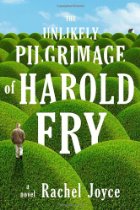
Marie C. Reviews The Unlikely Pilgrimage of Harold Fry by Rachel Joyce
The Unlikely Pilgrimage of Harold Fry, by Rachel Joyce. Published 2012 by Random House.
So,
after a spate of dark and heavy books, I was asking around on Twitter
one night for some what-to-read-next suggestions. One of my Twitter
friends mentioned a book she loved, The Unlikely Pilgrimage of Harold
Fry, by Rachel Joyce, which had been longlisted
for this year's Booker Prize and a galley of which happened to be
nestled in my piles of books somewhere. I'd dipped into it earlier in
the year and was interested enough to keep it around, but this
recommendation was enough to get it out of the pile and into my hands.
I really loved it.
One day Harold Fry gets a letter in the mail from a nurse caring for his old friend Queenie Hennessey. Queenie and Harold had worked together at a brewery; Harold was an introverted salesman, a loner in a jocular, hyper masculine culture, and Queenie the lone woman. They share a secret, a secret of Harold's; a long time ago, she did him an unfathomable favor, and now, as she lay dying from cancer, Harold feels a need to see her, to thank her, to make sure she's okay, so, without really meaning to, he starts walking the many miles from his home to her bedside.
As Harold's walk progresses, Joyce tells the story of Harold and his wife Maureen, a late-middle-aged couple whose marriage has basically disintegrated. Harold is a good man but emotionally stunted by abuse and abandonment by his own parents; Maureen had expectations for her life that were different from the way things turned out. Their relationship with their son David is at the heart of their troubles as a couple, and their story is explored gradually and quietly as Harold embarks on his pilgrimage.
Joyce alternates her narrative between Harold's walk and Maureen's own, private journey at home, as she reevaluates herself, her marriage, her husband and her son. The past and the present intermingle as Harold and Maureen make their way through terrain interior and exterior. Maureen starts off in denial of what's going on; she tells her neighbor that Harold is inside. Harold likewise has no idea what he's gotten himself into and finds himself beset by injury, hunger, loneliness and cold. He tells people what he's doing as he goes and soon finds himself to be a kind of celebrity, while Maureen actually starts to miss her husband and rethink their relationship.
I found the story, which is actually quite dark, to be moving but what I really admire about the book is how tightly it's structured. Everything is a metaphor for everything else; Harold's physical journey mirrors his psychic journey, his physical injuries and lack of preparation mirror his development from childhood to adulthood. The lack of affection and direction from his parents left him unprepared for adult relationships, for parenthood, for success at work. Now that part of his life is over and he has to figure out how to face his remaining years, what remains of his marriage and his understanding of his only child. And he's hanging it all on the success or failure of the visit with Queenie.
The Unlikely Pilgrimage of Harold Fry has the potential to be a big success with lots of different kinds of readers. It's a natural fit for people who liked Major Pettigrew's Last Stand by Helen Simonson, or Natasha Solomon's Mr. Rosenblum Dreams in English but it's a good deal more melancholy than those books. A meditation on grief, on what it means to succeed or fail, and on what it means to grow up and love other people, it's a wonderful and wonderfully engrossing story of an all-too-human man and his struggle to accept himself and what life has dealt him.
Rating: BUY
FTC Disclosure: I received a review copy from the publisher.
So,
after a spate of dark and heavy books, I was asking around on Twitter
one night for some what-to-read-next suggestions. One of my Twitter
friends mentioned a book she loved, The Unlikely Pilgrimage of Harold
Fry, by Rachel Joyce, which had been longlisted
for this year's Booker Prize and a galley of which happened to be
nestled in my piles of books somewhere. I'd dipped into it earlier in
the year and was interested enough to keep it around, but this
recommendation was enough to get it out of the pile and into my hands.I really loved it.
One day Harold Fry gets a letter in the mail from a nurse caring for his old friend Queenie Hennessey. Queenie and Harold had worked together at a brewery; Harold was an introverted salesman, a loner in a jocular, hyper masculine culture, and Queenie the lone woman. They share a secret, a secret of Harold's; a long time ago, she did him an unfathomable favor, and now, as she lay dying from cancer, Harold feels a need to see her, to thank her, to make sure she's okay, so, without really meaning to, he starts walking the many miles from his home to her bedside.
As Harold's walk progresses, Joyce tells the story of Harold and his wife Maureen, a late-middle-aged couple whose marriage has basically disintegrated. Harold is a good man but emotionally stunted by abuse and abandonment by his own parents; Maureen had expectations for her life that were different from the way things turned out. Their relationship with their son David is at the heart of their troubles as a couple, and their story is explored gradually and quietly as Harold embarks on his pilgrimage.
Joyce alternates her narrative between Harold's walk and Maureen's own, private journey at home, as she reevaluates herself, her marriage, her husband and her son. The past and the present intermingle as Harold and Maureen make their way through terrain interior and exterior. Maureen starts off in denial of what's going on; she tells her neighbor that Harold is inside. Harold likewise has no idea what he's gotten himself into and finds himself beset by injury, hunger, loneliness and cold. He tells people what he's doing as he goes and soon finds himself to be a kind of celebrity, while Maureen actually starts to miss her husband and rethink their relationship.
I found the story, which is actually quite dark, to be moving but what I really admire about the book is how tightly it's structured. Everything is a metaphor for everything else; Harold's physical journey mirrors his psychic journey, his physical injuries and lack of preparation mirror his development from childhood to adulthood. The lack of affection and direction from his parents left him unprepared for adult relationships, for parenthood, for success at work. Now that part of his life is over and he has to figure out how to face his remaining years, what remains of his marriage and his understanding of his only child. And he's hanging it all on the success or failure of the visit with Queenie.
The Unlikely Pilgrimage of Harold Fry has the potential to be a big success with lots of different kinds of readers. It's a natural fit for people who liked Major Pettigrew's Last Stand by Helen Simonson, or Natasha Solomon's Mr. Rosenblum Dreams in English but it's a good deal more melancholy than those books. A meditation on grief, on what it means to succeed or fail, and on what it means to grow up and love other people, it's a wonderful and wonderfully engrossing story of an all-too-human man and his struggle to accept himself and what life has dealt him.
Rating: BUY
FTC Disclosure: I received a review copy from the publisher.
Sunday, April 15, 2012
Marie C. Reviews Cooking with Fernet Branca by James Hamilton-Paterson
Cooking with Fernet Branca, by James Hamilton-Paterson. Published by Europa Editions 2009.
What a hoot this fun, fast-reading novel is. Set in the Tuscan hills, so full of British ex-pats that some call it Chiantishire (and our hero calls it Tuscminster), it tells the story of mismatched neighbors Gerald and Marta.
James Hamilton-Paterson alternates the points of view to comic effect. Marta comes from the fictional Eastern bloc country of Voyde, recently liberated from Soviet control. She's a musician composing a score for a sleazy yet charismatic film director. Gerald is a ghostwriter/biographer preparing a book for a vacuous celebrity. Both just want a quiet place to work; their shady realtor assures each that the other will be no trouble. But Gerald is also loud off-key singer and cheerful drunk always getting into scrapes and Marta has noisy late-night visitors and puzzles Gerald no end. Gerald thinks Marta is a frump and a hag. She thinks he's a fool and a pain. They hate each other, yet they can't stay away from one another. Let the shenanigans begin.
I really enjoyed the book. I didn't love it to pieces but it was fun. It didn't strike me as Wodehousian as some reviewers have commented; it was certainly funny and satirical though. I don't know, it just didn't have that Wodehouse light touch. There was a lot of hostility between the two, and Gerald in particular could be quite nasty and mean-spirited. Marta came off better if only because Gerald is so off in the way he sizes her up, and so superficial. So I didn't like him very much. But he was fun to watch. And oh my, those recipes look truly affreux, as the French would say.
If you're reading Europa books, this one is probably required at some point. I'm glad I read it. I'm going to read a bunch of Italian Europas for the next few months since I'm going to Italy in the fall with my family. This was a great book to get me going.
Wednesday, March 7, 2012
Marie C. Reviews The Sisters Brothers
The Sisters Brothers, by Patrick deWitt. Published 2011 by HarperCollins.
I picked up The Sisters Brothers because I had time to kill at the airport one day and because my friend Ann Kingman of Books on the Nightstand said it was great. Well, it is. It is great.
Set in the Gold Rush days of California and Oregon, The Sisters Brothers tells the story of a pair of hired killers and their last big job. Eli and Charlie Sisters are sent to kill Hermann Kermit Warm; Warm has invented a formula for finding gold and their boss wants the formula. Eli narrates the story, and he is a wonderful fictional creation. I don't know how to describe Eli except to say he's a nerd who ended up in the wrong profession. Overweight and bumbling, with a horse as desperate as himself for love and affection, he grows in self-confidence as events go slowly and tragically awry. When the story opens, Charlie is the "lead man," the one who fancies himself in charge. But little by little, slowpoke Eli takes the reins. Eli has a quiet charm and likability that almost make me forget he's a serial killer on a mission.
I have to say, I really loved this book. The story follows their adventures as they chase, and eventually find, Warm and his companion. Along the way they stay in flophouse hotels, shop for clothes, try to seduce women and even learn to brush their teeth. It's a picaresque that never gets dull and never ever loses its way. I can see why it was shortlisted for 2011's Man Booker Prize, although as a Western it seems at first glance an unlikely choice for a prestigious European literary award. But it really is that good.
And it's funny. Like, not exactly laugh-out-loud funny but chuckle-enough-to-get-attention funny. Eli has a terrific sense of humor and the situations the brothers find themselves in are frequently absurd to hilarious. Reading The Sisters Brothers makes me want to pick up my Charles Portis stash, or try something else outside my comfort zone. It's just as great a time as I've had reading all year. I'd strongly recommend it to just about any reader. There is some violence but nothing too graphic- although that one scene where the horse's eye- well, you'll see what I mean, no pun intended, if you take my advice and pick up this wonderful novel.
Tuesday, February 21, 2012
Marie Reviews The Long Song- 2010 Shortlist
The Long Song, by Andrea Levy. Published 2010 by Farrar, Straus and Giroux.
I took The Long Song for review a while ago and I knew I'd get to it eventually because it was a finalist for the 2010 Man Booker Prize, and I have to say I was seriously impressed with this multifaceted, engrossing novel.
Set in Jamaica on the cusp of the end of slavery, Andrea Levy tells the story of Miss July, a slave in the household of one Caroline Mortimer, an English widow come to Jamaica. Caroline Mortimer, always referred to by her first and last name, is a comic figure, an emblem of the ridiculous and the absurd. She takes a shine to July, calls her "Marguerite" and makes July her personal servant. Along the way, they get through the Baptist War, see the end of slavery in Jamaica and learn to live with each other in the new era of freedom.
But don't mistake The Long Song for a feel-good novel about relationships between whites and blacks, or one in which the blacks teach the whites some lessons about life. Politics and social realities may change; attitudes change but little. July, whose white Scottish father raped her black Jamaican mother, finds that she is in a peculiar position in the complex racial hierarchy of the island, where how much white blood someone has determines their social standing among blacks and women try to "raise their color" by sleeping with white men. July falls in love with a white man, Robert Goodwin, who appears to be passionately devoted to her. He talks a good game but eventually he shows himself to be no better than July's own father when it comes to his true esteem for her.
I really loved The Long Song. I love how Levy made Caroline Mortimer sympathetic at first, then gradually shifts into satire and absurdity, and I love how she shows the different characters and events with respect for all- or mostly all. I could understand why the characters did what they did, and how their actions seemed right to them even when they seemed very wrong to me. The characters are complex people- there are no cartoon saints and no cartoon villains in this book. The narrator, the elderly July, is funny, irascible and just ever so slightly unreliable, and her voice makes the book the delightful, thoughtful and fascinating wonder that it is. Literary and popular-fiction readers will enjoy this book and I recommend it highly.
Thursday, January 26, 2012
Marie C. Reviews The Sense of an Ending, by Julian Barnes
The Sense of an Ending, by Julian Barnes. Published 2011 by Random House.
Winner of the 2011 Man Booker Prize and latest novel by acclaimed British writer Julian Barnes, The Sense of an Ending is a must-read for any reader of literary fiction. The book tells the story, in his own words, of middle-aged Tony Webster and his lifetime of regret around his relationship with two people- Veronica, an ex-girlfriend, and Adrian, a close friend from school. Lifetime of regret isn't quite right; he doesn't find out until very late in his story that he has any reason to regret but when he does, it's as though the weight of all of his decisions crashes upon him and he's left to sort through the rubble alone.
The theme of the novel is laid out early, as a high-school-aged Adrian is talking to a teacher about how to write history fairly: "That's one of the central problems of history, isn't it, sir? The question of subjective versus objective interpretation, the fact that we need to know the history of the historian in order to understand the version that's being put in front of us." And herein lies the central challenge of this book. Tony is telling this story from the future, after the events have taken place; in the opening pages, as we're getting to know the characters, their futures, and Tony's, is hidden from us but not from the man telling the story. He knows things we don't yet, and these things color the way he tells the story. We can't understand anything he's saying until we know everything and we don't know everything until the very end.
Therefore, re-reading The Sense of an Ending is mandatory!
However the book is short enough, and more than wonderful enough, to make a reread easy and worthwhile. Soon after this point in the story, Tony meets Veronica, and their relationship forms the basis of the rest of the book. Even after their romance ends, they continue to interact in meaningful ways; one could say that Tony's relationship with Veronica is the central and defining one of his life, even as he tries to argue that other women were more important. That lie is one of many, maybe not lies exactly but self-deceptions Tony tries to sell the reader. The final secret is revealed obliquely, which tells us something about Tony's ability to process what he's learned and face it.
The Sense of an Ending is a wonderfully, intricately crafted unreliable-narrator story starring a perfectly ordinary man who, through one act of cruelty by whose impact he himself seems baffled, upends four lives for years to come. It's also the story of his reckoning and acceptance of what he's done as well as his ultimate irrelevance. And it is a book that deserves an immediate re-read. But you'll want to- you really will. It's just that good!
This counts towards the Complete Booker Perpetual Challenge.
Wednesday, August 24, 2011
Marie C.'s review: THE BONE PEOPLE, by Keri Hulme
The Bone People, by Keri Hulme. This edition published 1986 by Penguin.
Winner of the 1985 Booker Prize, The Bone People is a staggering literary novel. Keri Hulme's long and somewhat experimental novel focuses on an idiosyncratic family-by-choice in roughly modern-day rural New Zealand. Kerewin is an artist, solitary and self-sufficient; she lives in a tower and spends her days alone and working. One day, out fishing, she finds an enigmatic, silent little blond boy named Simon. They form a bond. She meets his father, Joe, a big man with a temper and a fondness for drink, which he shares with Kerewin. But Joe isn't exactly Simon's father, and his story, and the story of his history and his future with Joe make up the plot of this unusual novel.
Hulme's writing is dense and poetic, and her characters live in close contact with the natural world:
Sorting out all those contradictions makes up the demanding work of parsing through this very accomplished and important novel. Hulme creates incredibly rich characters in all three of her leads, even mute Simon. And she sets up a heartbreaking situation out of her characters' complex psychology. She asks the reader some really hard questions about who it's possible to love, and under what circumstances. Hulme's style means sometimes it's a little hard to know what's going on; I would suggest taking advantage of a cheat sheet if you find yourself having a hard time keeping track of the plot, especially in the latter third of the novel. But I do strongly recommend The Bone People to anyone up for a read that will challenge both intellectually and emotionally.
You can see my review on my blog, Boston Bibliophile, here.
Winner of the 1985 Booker Prize, The Bone People is a staggering literary novel. Keri Hulme's long and somewhat experimental novel focuses on an idiosyncratic family-by-choice in roughly modern-day rural New Zealand. Kerewin is an artist, solitary and self-sufficient; she lives in a tower and spends her days alone and working. One day, out fishing, she finds an enigmatic, silent little blond boy named Simon. They form a bond. She meets his father, Joe, a big man with a temper and a fondness for drink, which he shares with Kerewin. But Joe isn't exactly Simon's father, and his story, and the story of his history and his future with Joe make up the plot of this unusual novel.
Hulme's writing is dense and poetic, and her characters live in close contact with the natural world:
And here I am, balanced on the salt-stained rim, watching minute navyblue fringes, gill-fingers of tubeworms, fan the water...put the shadow of a finger near them, and they flick outasight. Eyes in your lungs...neat. The three-fin blenny swirls by.. tena koe, fish. A small bunch of scarlet and gold anemones furl and unfurl their arms, graceful petals, slow and lethal...tickle tickle, and they turn into unterestinglumps of brownish jelly...haven't made sea-anemone soup for a awhile, whaddabout it?...The narrative structure is basically linear apart from the first chapter but Hulme changes the point of view often, gives her characters extended internal monologues and peppers their language with Maori words and phrases (both Kerewin and Joe have Maori background). It becomes obvious that Simon and Joe's relationship is not what it seems, and that Simon is being horribly abused. Hulme draws Joe's psychology so realistically that the reader can see how it happens, too. And Simon has troubles of his own, as we learn through his rare moments of internal monologue. Although iconically angelic in appearance, he is a troubled little boy whose troubles only continued when he met Joe and Joe's late wife. Now, ironically, Joe and Kerewin may be the best shot Simon has at a loving family.
Sorting out all those contradictions makes up the demanding work of parsing through this very accomplished and important novel. Hulme creates incredibly rich characters in all three of her leads, even mute Simon. And she sets up a heartbreaking situation out of her characters' complex psychology. She asks the reader some really hard questions about who it's possible to love, and under what circumstances. Hulme's style means sometimes it's a little hard to know what's going on; I would suggest taking advantage of a cheat sheet if you find yourself having a hard time keeping track of the plot, especially in the latter third of the novel. But I do strongly recommend The Bone People to anyone up for a read that will challenge both intellectually and emotionally.
You can see my review on my blog, Boston Bibliophile, here.
Friday, June 17, 2011
Marie's Review: The Elected Member, by Bernice Rubens
The Elected Member, by Bernice Rubens. This edition published 2001, Little, Brown Book Group.
The Elected Member, by Bernice Rubens, won the second Booker Prize in 1970, and it's a good book but kind of a downer. It's the story of a Jewish family in roughly contemporary London, struggling as Norman, the son and prize of the family, falls deeper and deeper into chronic drug abuse.
When the book opens, Norman is relapsing once again, after the family has tried again to get him to quit. He hallucinates; he's paranoid; he manipulates his father and sister through guilt and love. His father, Rabbi Zweck, is an old man in his declining years still mourning the loss of his wife Sarah and his daughter Esther, although Esther is not dead. His other daughter, Bella, lives with him and Norman and helps take care of them both. She is deeply dysfunctional herself, a kind of overgrown child in ankle socks. As the story progresses and Norman is institutionalized, we learn what lays behind Norman's drug use, Bella's stunted growth and Esther's exile.
Much of the book takes place in the mental hospital where Norman is sent to try once again at recovery, and these scenes have about them the air of a bitter black comedy. Rather than recover here, Norman finds fellow patients to enable him and continues to manipulate Bella as well. Rabbi Zweck and his daughter visit him while Esther comes out from the shadows to try to help, too. It takes a family tragedy to bring the siblings around but even then the future is uncertain, with Norman taking comfort in a most unlikely quarter.
The Elected Member is a beautifully written novel about a deeply troubled family on the brink; it's not a feel-good novel and the ending isn't particularly happy but I found it nonetheless to be a very satisfying read. The characters were very well-drawn and convincing, and I like the way the secret at the core of the book unwinds itself slowly. The issues it raises haven't aged; it's just as relevant as ever and might make an interesting and off-beat book club pick for brave readers. But I think any reader of literary fiction should seriously consider adding it to his or her reading list.
Wednesday, May 11, 2011
Marie's Review: Moon Tiger, by Penelope Lively
Moon Tiger, by Penelope Lively. This edition published 1989 by Harper Perennial. Paperback.
Winner of the Man Booker Prize in 1987, Moon Tiger is the bedside confession and life story of Claudia Hampton, writer of popular histories now on her deathbed. She says she will write the history of the world so she tells her own story and that of her family- her brother Gordon and his wife, who knows Claudia to be the most important woman in her husband's life; her daughter Lisa, the doggedly average daughter of the larger-than-life Claudia; Lisa's father, distant and aristocratic; and her lover, Tom, who she meets in Egypt during World War 2 and loses almost as soon as she finds him.
First of all, Lively's writing is incredible. Her descriptions of characters and her eye for detail bring the most everyday situations to life. You know these people; you can feel Lisa's pain especially at growing up in the shadow of her flamboyant mother, a woman who doesn't want her daughter to call her mother because it's just too ordinary, and ordinary is what Claudia can never be. Although Tom is the lover of her life, the man for whom she pines to her dying breath, the real love of her life is her brother Gordon, the only relationship that lasts.
The segments of the book taking place in Egypt are the most colorful; Lively makes you feel the heat, the crush of crowds, the empty and yet seductive power of the desert. It's also where Claudia experiences the only real love she ever feels and her passion for Tom bring the landscape alive. England, Europe and America feel duller, flat, because she has no emotional ties there- no connective tissue. Tom's journals, which she reads at the end of her life, have about them a quiet tenderness that ease her final days.
At heart Moon Tiger is a character study of a strong and difficult woman; Claudia is a wonderfully, vividly drawn character- as are all the characters in the book. She's not perfect, but the book is, in its way, a perfect, gentle, subtle portrait of an unusual woman and her unusual life. I relished every drop of Lively's beautiful writing and thoroughly enjoyed this fantastic, moving novel
Tuesday, May 10, 2011
Marie's Review: Life & Times of Michael K, by J.M. Coetzee
Life & Times of Michael K., by J.M. Coetzee. Published 1985 by Penguin (Non-Classics). Paperback.
Winner of the Man Booker Prize in 1983, Life & Times of Michael K. is a short yet deeply engrossing novel about a young man, Michael K., wandering alone through the deep countryside of South Africa amidst war and chaos. Michael is a youngish man living with his aging mother in the city as the story opens; hare-lipped, under-educated and somewhat simple, he works as a municipal gardener until his mother takes ill and asks him to take her to the countryside farm where she grew up. Along the way she dies, and Michael is left on his own with little money and few resources. He subsists off the land and passes through a prison-like camp for the poor and dispossessed, all the while trying to maintain his independence and dignity despite a society determined to strip these things away.
The book is divided into three main parts. The first is told entirely from Michael's point of view and Coetzee tells his story meticulously, in great detail and without pause. I thought the lack of chapter breaks would exhaust me but I found his story absolutely riveting. One thing follows on the next, day by day, bit by bit, until Michael has shed almost all the trappings of human society. Then the book changes gear, and Coetzee introduces a new voice and provides an altogether different point of view on Michael. Having spent so much time with him and in such intimate circumstances, it's jarring to have him removed so, pulled away if you will, but I loved this new perspective and the information Coetzee shares with the reader in this way. When we return to Michael in the final section, it's with a renewed appreciation for the challenges he faces and his resources to succeed.
I can't say I was as emotionally challenged by Michael K. as I was by Coetzee's later novel Disgrace (also a Booker winner) but I found Michael K. to be just as riveting, and in some ways, just as draining. We spend so much time in such close proximity to this man and his transformation is so gradual as to be almost unnoticeable, and so convincing as to be inevitable. The excellent second part adds another layer of depth and fascination- not to mention suspense. The fact that Michael's race is never mentioned in a country so charged by racial tension adds another challenge for the reader; Coetzee doesn't make it easy for us to place Michael, or judge him, or anticipate how other characters will do the same. I love how Coetzee can challenge us to think about race without handing us an easy answer. Highly recommended for readers of literary fiction, Coetzee once again proves himself to be a master of it himself.
Saturday, April 2, 2011
Marie's Review of HELIOPOLIS, by James Scudamore
Heliopolis, by James Scudamore. Published 2010 by Europa Editions. Paperback.
Heliopolis is the story of a boy and his city; Ludo, the boy, and São Paulo, the city, exist in a sense because of each other. Ludo is the child of a cook for a wealthy family; according to family lore, Rebecca, the matriarch, found Ludo and his mother in a favela, or slum, where Rebecca was doing charity work. She recognized Ludo's mother's talent and brought her to work for her husband and daughter. Rebecca and her husband, a wealthy supermarket baron, raised Ludo alongside their daughter Melissa, with whom Ludo, now in his twenties and working in an ad agency, is having an affair.
Scudamore alternates between the past and the present as Ludo navigates the city and the drastic class and economic differences that define it and the people who live there. Ludo's adoptive family represents the ultra-rich upper class inhabiting isolated gated communities protected by armed guards or bullet-proof high-rises; relaxing in obscene luxury but afraid to walk the streets, they live in gilded prisons. Meanwhile the poor teem in filthy, inescapable poverty that drives them to desperation and marks them indelibly as outcasts.
Ludo represents the middle ground, neither rich nor poor; a child of the slums raised among the rich, he's derided by both and accepted by neither. The city of São Paulo is as much a character as any person in the book, and Scudamore describes its streets and buildings and squares like something out of science fiction or dystopia. It was long-listed for the Man Booker Prize in 2009 and the novel is arresting and heartstopping at the same time, a suspenseful literary page-turner about class and identity and the way one defines the other. Scudamore sets up several mysteries at the beginning and my only quibble with the book is the way they peter out by the end; otherwise though, Heliopolis is an engrossing, smartly written character study of a young man and the city that made him who he is.
Click for my interview with James Scudamore.
Thursday, March 17, 2011
Marie's Review- Troubles, by J.G. Farrell
Troubles, by J.G. Farrell. Originally published 1970; this edition 2002, by NYRB Classics. Paperback.
A phenomenal work of literary fiction, J.G. Farrell's Troubles has long been hailed as his masterpiece; a change in the rules for Booker Prize eligibility kept it out of consideration at the time it was published but it was resurrected in 2008 and recognized with the Lost Man Booker Prize. (Off-topic, but I love that the Man Booker committee has been recognizing heretofore unrecognized works with hindsight-prizes like this.)
Set in Kilnalough, Ireland, in 1921, in a dilapidated hotel among a motley cast of the equally dilapidated Anglo-Irish upper class, Troubles stars Major Brendan Archer, a veteran of the first World War and fiancé of the elusive Angela Spencer, daughter of the proprietor of the Majestic Hotel, Edward Spencer. The Majestic's name has taken on the quality of bitter irony as the hotel is literally falling to pieces around its owners and residents, a group of elderly ladies left stranded by their own declining fortunes. The Major (as is known throughout the book) arrives to find nothing as he expected. Angela is mysteriously ill, Edward is slowly going mad and the Major finds himself falling hard for caustic Sarah Devlin, who is, of all things, a Catholic.
The novel is on the longish side, and the action is quotidian and slow; there is no powerful central plot driving the narrative but rather a long series of little things- conversations, encounters, minutiae. The Major stays at the hotel for a time, goes away, comes back, and goes away again. Edward becomes increasingly paranoid about the social and political deterioration of British rule in Ireland, and about Sinn Fein (the "Shinners") aggression, and the threat moves closer to home when his son marries a Catholic and runs away. The narrative is punctuated with news items about the state of British rule in Ireland, India and elsewhere in the Empire to underline the sense of instability. Meanwhile, a colony of feral cats slowly takes over and the building continues to fall apart.

But don't think Troubles is just some grim, depressing book. Farrell's writing is razor-sharp and funny and note-perfect; if you like black humor, Troubles is the book for you. A little knowledge of the political situation in Ireland of the 1920s is helpful but not necessary. It reminded me a little of Guiseppe de Lampedusa's wonderful The Leopard, also about a society, and a social class, of the brink of transformation and the end of its useful life; both books culminate in a ball whose consequences echo through the lives of the characters. It's a richly satisfying, beautifully-written, smart, knowing work of historical fiction with just about everything going for it. Highly recommended for literary-fiction readers and readers with a strong interest in Ireland, it's a wonderful, wonderful novel.
Wednesday, February 23, 2011
Marie's 2011 Booker Challenge Post
I'm going to participate in 2011 Complete Booker Challenge at the Booker's Dozen level, with an eye to completing 12 Booker-Prize-winning (or nominated) books this year.
I don't have a complete list yet; I have a stack of Booker winners unread in my TBR pile (more than a dozen!) and unheard-of numbers of long- and short-listed titles, so this is a great opportunity to work my way through. My goal is to read one winner a month and maybe a nominee or two here and there as time and interest allow. So far in 2011 I've read
- Moon Tiger by Penelope Lively (winner 1987)
- Hotel du Lac by Anita Brookner (winner 1984)
- Heliopolis by James Scudamore (longlist 2009)
It's going to be a great year in Booker books!
Marie's Review- Offshore, by Penelope Fitzgerald
Offshore, by Penelope Fitzgerald. Published 1979 by Collins. This edition published 2003 by Everyman's Library, Hardcover.
Winner of the Booker Prize in 1979, Offshore is quiet, short novel about a group of eccentric characters living in houseboats on the Thames River in London. The main focus is on Nenna and her children, precocious Tilda and milder Martha; Martha longs for normalcy while Tilda embraces the chaos of houseboat river living. Grace is the name of their boat; Nenna's husband, Edward, has left them. Richard is a retired Royal Naval Reserve officer, very comme il faut, who lives on a very nice boat. His wife, the beautiful Laura, is discontented with barge life. Maurice is a small-time criminal and male prostitute. A pair of minor tragedies upset this delicately poised group and it slowly disintegrates.
Life on the Battersea Reach is a world apart from life on the shore, with its own rules and codes of conduct. Some find it quite suitable, like Nenna and Richard, to whom she is attracted. Others, like Laura and Martha, want a so-called normal life on land. Nenna's husband Edward is harmless and feckless and the two just can't seem to find common ground. Meanwhile their daughters are growing up and involved in little intrigues of their own.
I really enjoyed Offshore. It's a little gem about personalities and lifestyles intersecting and mingling like slow-moving driftwood at the water's edge. While short, Offshore is not a quick read but rather requires a careful and attentive reader. The characters are vivid and detailed; the setting is unusual and fascinating. I re-read it as soon as I finished just to savor its little nuances and details. A tiny masterpiece, Offshore should be on the shelf of every reader of literary fiction.
You can see this review on my book blog Boston Bibliophile.
Tuesday, January 25, 2011
Marie's Review- Hotel Du Lac, by Anita Brookner
Hotel du Lac, by Anita Brookner. Originally published 1984. This edition 1995 by Vintage Contemporaries. Paperback.
Hotel du Lac is a quiet novel that nonetheless has a lot to say. Winner of the 1984 Booker Prize, it's the story of Edith Hope, a writer on a self-imposed exile at an out-of-season Swiss hotel, which she shares with a small group of (mostly) women. Mrs. Iris Pusey is a narcissistic grande dame on perpetual holiday with her spinster daughter Jennifer; their primary occupation is consumption- shopping and eating. Monica is a tall, striking woman accompanied by a small dog but otherwise alone, a single middle-aged woman looking for what the Puseys already have, a wealthy man to support her. An older woman also resides at the hotel, staying on until the end of the season, at which time her family will send her elsewhere to be looked after. And then there is Edith, alone for entirely different reasons, who forms slight attachments to each but remains definitively on her own.
What we do know about Edith is that she's desperately in love with David, a married man and art dealer, to whom she writes detailed letters about the people and goings on at the hotel. But David is not the primary scandal she's escaping, and he won't be her redemption, either. That story unfolds slowly as Edith gets to know a Mr. Neville, a single and well-off man also in residence at this placid hotel that nonetheless buzzes with the quiet desperation of its inhabitants.
At the core of this slim novel is character- Brookner's and Edith's sharp character studies of the ladies, especially the Puseys, and Edith's own arc as she makes difficult choices about the next stage of her life. For a long stretch her future is open-ended and uncertain as she steps through each day walking the town, writing and navigating the genteel minefield of the other ladies' own emotional landscapes. The setting reflects Edith's state of mind, perpetually gray and blank. Color comes from the ladies' clothing and conversation. She's recovering from a major trauma, and more than that, has to decide what to do next; uncertainty is the dominant tone. Towards the end decisions agendas are revealed that change that landscape and lead to Edith's final choice, and it feels so right and well-drawn that it's hard to imagine it turning out any other way.
Hotel du Lac is a fine literary read that readers of thoughtful womens' fiction will savor and enjoy. Brookner mixes pathos and humor- her portrait of Mrs. Pusey in particular has moments of real hilarity- in a novel that resembles Jane Austen written in a contemporary style, but with an emphasis on the pathos. She uses the very Austenian theme of women's economic vulnerability but instead of marriage solving life's problems, she asks if the material rewards of dependence engender a kind of complacency or even rot. But the novel is smarter than to be so simple-minded in its message; Brookner also sets up contrasts that ask if being alone is the worth the price it demands as well. Overall thoughtful, thought-provoking and lovely, Hotel du Lac is a beautifully crafted narrative that will reward the careful reader.
See this review on my blog, Boston Bibliophile.
Subscribe to:
Posts (Atom)