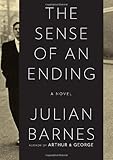
Showing posts with label 2011 - The Sense of an Ending. Show all posts

Wednesday, September 12, 2012

2011 - The Sense of an Ending

A friend wrote recently on Facebook that when you lose someone you love there is no such thing as ’closure’, ‘only days when the loss doesn’t hit you like a truck’. I thought of this quite a bit as I read Julian Barnes’ The Sense of an Ending. The narrator Tony Webster, looking back over his long life, ponders whether he has made the most of it. He’s a peaceable man (or so he says) and he likes things settled, tidy. He wants this so-called closure but it evades him:
Had my life increased, or merely added to itself? … There had been addition - and subtraction – in my life, but how much multiplication? And this gave me a sense of unease, of unrest. (p88)
When his ‘chippy, jealous and malign’ younger self (p97) comes back to shock his older peaceable self that ‘finds comfort in his own doggedness‘ (p89) his unrest escalates. He had thought himself safe from follies melted away by the frailties of memory because as we age ‘the witnesses to our lives decrease, and with them our essential corroboration’. (p98)

This made me think about the selves we create on Facebook, GoodReads, Twitter and yes, on blogs like this one: these digital selves are a kind of testimony about who we are. The longer we engage in them with people that we actually know, the more we recognise that these digital selves are not always corroborated by face-to-face contact. Digital selves are edited, filtered according to some view of the self not necessarily shared by others, and these selves are plastic – not in the sense of fake (or not usually, not with my friends) but in the sense of malleable.

Tony’s view of himself is that he’s a more-or-less reasonable sort of fellow. He looks back wryly at his adolescent self when he thought (like most of us) that he and his friends were cool observers of the world and comfortable with their own superiority. Now he realises that by the laws of mathematics and philosophy most people are average and so is he. He might even be complacent about this except that the malleable self (and some of the toys of the digital age such as email and Google) startle him into realising that actually he was not only culpably vindictive as a young man but that he’s capable now of revenge, spite and harassment to an extent which imperils his fond relationship with his only confidante, his ex-wife Margaret. He uses those digital toys (and his own doggedness) to do some rather nasty things!

To read the rest of my review, please visit my ANZ LitLovers blog.
I read and blogged this Booker Prize winner on September 12th 2012.
Cross-posted at GoodReads.
Lisa Hill, ANZ LitLovers

Sunday, April 1, 2012

The Sense of an Ending by Julian Barnes review by Athena

Originally posted at Aquatique.

The Sense of Ending

This was my first Julian Barnes book, and I don't think it will be my last. I'm curious about his other works now. I think I rather enjoyed myself even though there were few real characters and a perplexing ending.

The themes of the novel are those of memory, history, self-awareness, and mortality. I think given the shortness of this novella, Barnes tackled a lot in a short period of time. An excerpt from the book:

I certainly believe we all suffer damage, one way or another. How could we not, except in a world of perfect parents, siblings, neighbours, companions? And then there is the question, on which so much depends, of how we react to the damage: whether we admit it or repress it, and how this affects our dealings with others. Some admit the damage, and try to mitigate it: some spend their lives trying to help others who are damaged; and then there are those whose main concern is to avoid further damage to themselves at whatever cost. And those are the ones who are ruthless, and the ones to be careful of. (p 44)

As I read this book, I didn't expect much in the way of plot movement and so when the plot did move by Tony, the narrator and protagonist, receiving a money from the will of an ex-girlfriend's mother, I was intrigued. From then on, I chased the novel's ending for more on the mysterious Adrian and the full story about him, Veronica, and Sarah. I kept waiting for the twist; there was such a build up to it.

I wasn't annoyed with any of the characters even though it seemed there was not much to give them credit for. Tony is self-obsessed, but I didn't mind his take on things. He's analyzing himself and the whole story seemed to be about him thinking back on his life so I could understood the self-reflection. I was irked with Veronica who kept saying, "You don't get it and you never will!" and I just kept thinking, then tell him about it! She seems to have regressed since young Veronica was about to communicate to Tony about somethings, but not about 'this' (or whatever it is he needs to get) even after their meetings?

When I reached the last two pages, I was perplexed with the ending. Tony said he understood, but I felt dumb because I didn't. I had to go online and read other reviews and blogs to realize that I was suppose to question the ending and what had really happened. Did Tony block out so much of his memory? Why the money from Sarah? Lots of questions. It did make me think which is good enough for any book. I wasn't irked by the lack of ending though.

Books this reminded me of: You Deserve Nothing (which was the last book I read and fit with the earlier chapters of this book), Ian McEwan works such as Atonement, Amsterdam and Solaris, and Iris Murdoch's The Sea, The Sea (not sure why other than it's a Booker by an English person - perhaps it was the self-obsession). Barnes and McEwan have the dry and philosophical English contemporary literature that the Booker panel seems to love. I don't hate McEwan, but I actually think I was less annoyed with Tony in The Sense of Ending than I have been with any of McEwan's narrators. Makes me wonder why I've already read three McEwan novels, but I digress.

I think Barnes has said that you must read the book at least twice to get it. I doubt I will even though I did enjoy this book for the most part. I wasn't as annoyed or irked with the ending or the seeming plot holes as other readers, but I'm not that involved. Maybe I am just use to literary novels (specifically, Booker winners) having these kind of endings. At least I didn't want to throw this one across the room like I did God of Small Things.

Have you read this book and what did you think of it? What are your theories on what really happened? Or did you not care at all?

Here are a couple of links on what other readers thought of the book:

The Man Booker Prize forum thread on the book
The Aslyum Book Review with comments

Thursday, January 26, 2012

Marie C. Reviews The Sense of an Ending, by Julian Barnes

The Sense of an Ending, by Julian Barnes. Published 2011 by Random House.

Winner of the 2011 Man Booker Prize and latest novel by acclaimed British writer Julian Barnes, The Sense of an Ending is a must-read for any reader of literary fiction. The book tells the story, in his own words, of middle-aged Tony Webster and his lifetime of regret around his relationship with two people- Veronica, an ex-girlfriend, and Adrian, a close friend from school. Lifetime of regret isn't quite right; he doesn't find out until very late in his story that he has any reason to regret but when he does, it's as though the weight of all of his decisions crashes upon him and he's left to sort through the rubble alone.

The theme of the novel is laid out early, as a high-school-aged Adrian is talking to a teacher about how to write history fairly: "That's one of the central problems of history, isn't it, sir? The question of subjective versus objective interpretation, the fact that we need to know the history of the historian in order to understand the version that's being put in front of us." And herein lies the central challenge of this book. Tony is telling this story from the future, after the events have taken place; in the opening pages, as we're getting to know the characters, their futures, and Tony's, is hidden from us but not from the man telling the story. He knows things we don't yet, and these things color the way he tells the story. We can't understand anything he's saying until we know everything and we don't know everything until the very end.

Therefore, re-reading The Sense of an Ending is mandatory!

However the book is short enough, and more than wonderful enough, to make a reread easy and worthwhile. Soon after this point in the story, Tony meets Veronica, and their relationship forms the basis of the rest of the book. Even after their romance ends, they continue to interact in meaningful ways; one could say that Tony's relationship with Veronica is the central and defining one of his life, even as he tries to argue that other women were more important. That lie is one of many, maybe not lies exactly but self-deceptions Tony tries to sell the reader. The final secret is revealed obliquely, which tells us something about Tony's ability to process what he's learned and face it.

The Sense of an Ending is a wonderfully, intricately crafted unreliable-narrator story starring a perfectly ordinary man who, through one act of cruelty by whose impact he himself seems baffled, upends four lives for years to come. It's also the story of his reckoning and acceptance of what he's done as well as his ultimate irrelevance. And it is a book that deserves an immediate re-read. But you'll want to- you really will. It's just that good!

This counts towards the Complete Booker Perpetual Challenge.

Wednesday, January 4, 2012

Athena K's Review - The Sense of an Ending


The first thing I remember reading in this short snappy novel is its first Library of Congress Subject Heading. These types of headers are published in every novel catalogued by the U.S. Library of Congress (I'm assuming international readers aren't as familiar with them, but maybe I'm wrong - anyone?).  I like to check them out to get a sense of a novel's themes, locations, and characters -- and because I'm a big nerd.  The first subject heading tag read:  "Middle-Aged Men -- Fiction."  Not the most effective way to catch my attention.

Luckily, I read more.  In fact, I read the entire book in one sitting because I couldn't put it down.  The story itself was simple enough.  In fact, the entire plot can be (and is) reduced to a single line of equation about 2/3 of the way through the book.  But the way Barnes related the story, intermingling the main character's reflections, gave the story a powerful emotional charge. The bisecting of the story into two unequal parts was very effective, and I'm sure you can look to any number of other reviews for some truly fantastic snippets of quotes on memory, self-delusion, and storytelling.  Once through the first time, I realized that I had probably missed picking up on an enormous number of tiny clues, and literary moments that would make a re-read thoroughly enjoyable.  I will definitely read this book again.

Overall, I agree that this was perhaps not a "major" work - it was not an epic, it did not effect a major change on the way I read or see the world.  But it was a thoroughly enjoyable, intelligent, and compelling novella.  This win reminded me of the win of Ian McEwan's Amsterdam - another great little novel by a well-deserving author, and I'm not sad that it won.

Monday, November 21, 2011

Matthew's Review - The Sense of an Ending


On the back of the hardcover, just above in the ISBN barcode, in the tiniest font, the book helpfully tells you that this is "Literary Fiction". Not just "fiction" but "Literary". This separates The Sense of an Ending from the rest of the unwashed masses of fiction, the novels without ambition to be about things. Certainly, Julian Barnes' Booker Prize-winning novel is about things. The first paragraph announces these great big themes of time and memory, alerting the reader that this is a Great Work of Fiction about Great Themes.

While this sounds facetious or dismissive, The Sense of an Ending is a readable novel. It helps that its length is easily manageable in one or two sittings. The best compliment I can pay this novel is that at 150 pages, it certainly doesn't overstay its welcome. Its brief length should not distract from the novel's lofty ambitions of theme.

Every novel should aspire to be something other than a ripping good yarn. This is particularly a factor in what differentiates a novel from a story: it does something new. The Sense of an Ending has great aspirations for telling a story about memory, ageing, and history wrapped up in a man's self-centered and average life. Tony Webster, the protagonist, pontificates endlessly about his own history, repeating the compulsion to pick over memories ad infinitum. Memories come to light after being forgotten for forty years, and then eventually, new history comes to light, changing how he perceives everything.

One can see that The Sense of an Ending wants to be a big novel packaged into a shorter more accessible work. It is the novel's compulsion to be literary that makes this story seem less. If there was ever a novel that felt like pure artifice, here it is. The reader can feel Barnes hovering over every sentence, filling it to the brim with meaning and symbolism, until the rather short novel topples over from the author's ambitions to be taken seriously. There is just so much material in this novel that pertains to the classical goals of high art that the story positively suffocates.

Anytime the story threatens to get interesting, Tony/Barnes derails it with long paragraphs about the fickleness of memory, or aphoristic language about old age. This is a novel where each sentence is designed to be the epigraph in another novel. This is not a compliment.

It might appear that I disliked, or even hated, the novel. Far from it. I enjoyed it for what it was, which was a rather simple and cleverly structured novel about history and memory and where the two should meet (again, another theme announced constantly with aphorisms). What prevented me from thoroughly appreciating the novel was the author's unsteady and forced hand, a presence wholly unwelcome. The story, characters, and theme should have done all the work, rather than the author or his arsenal of aphorisms.

[Cross-posted from my blog]

Saturday, November 19, 2011

Laura's Review - The Sense of an Ending

Now in his 60s, Tony Webster is retired, divorced, and taking stock of his life. He begins by recounting his youth and young adulthood, and his social circle, which revolved around Adrian, the aloof ringleader. These relationships falter on leaving school, and when Adrian begins dating Tony's former girlfriend Veronica. Years later, Veronica's mother passes away. Tony is quite surprised to learn she left him a bequest. He gets back in touch with Veronica, and makes a nuisance of himself in attempts to understand the bequest. The reader learns a lot about Tony's true self, even as Tony remains oblivious. As Veronica says repeatedly, "You just don't get it."

Julian Barnes packed so much into this novella, and yet I'm hard pressed to explain just how he did it. The plot appears straightforward, as everyday events unfold through Tony's eyes. But it is actually layered with complexity, requiring the reader to flip back and forth to see what they missed on a first reading. Little by little, you realize how much memories are influenced by what you want -- and don't want -- to remember. Small but important details can escape notice, leaving two people with completely different impressions of events. And sometimes these different points of view have tragic consequences. So it came as a complete shock when Tony finally "got it," and I understood what was actually going on all those years. Or at least I think I understand. I may need to read it yet again.

With a series of haunting images that set the stage, an unreliable narrator, and an overall sense of loss, this book will stay with you long after turning the last page. As Tony says:
What you end up remembering isn't always the same as what you have witnessed. (p. 1)


Cross-posted from my blog

Tuesday, September 27, 2011

Tony Messenger - 2011 Shortlist - The Sense of an Ending - Julian Barnes

Here is a real live advertisement for the paper book, beautiful black bordered paper, neat size that is so easy to hold, almost diary like in its feel and size. Sorry Kindle fans, this is one you really need to have in the old fashioned book style. But is that showing my age?

We live in time – it holds us and moulds us – but I’ve never felt I understood it very well.

Is this Julian Barnes’ year? This is his fourth Booker Prize Shortlisted novel. He lucked out to Anita Brookner’s “Hotel Du Lac’ in 1984 with “Flaubert’s Parrot”, was shortlisted in 1998 with “England, England” (lost to Ian McEwan’s “Amsterdam”) and again didn’t win the gong in 2005 with “Arthur and George” when John Banville’s “The Sea’ took home the prize.

If you are like me, it is only every ten years or so that you come across a “masterpiece”, well I think 2011 is the year I came across another.  But can I recall the last book that moved me so much?

We live with such easy assumptions, don’t we? For instance, that memory equals events plus time. But it’s all much odder than this. Who was it said that memory is what we thought we’d forgotten? And it ought to be obvious to us that time doesn’t act as a fixative, rather as a solvent. But it’s not convenient – it’s not useful – to believe this; it doesn’t help us to get on with our lives; so we ignore it.

There are numerous reviews out there which will give you a high level sketch of the plot of this novel, so there’s not much point in replicating the précis here.  Needless to say at 150 pages and with not a single word wasted, this could be knocked over in a single sitting. I took much longer, re-reading passages, stopping and dwelling for sometime, allowing the whole concept of time and memory slowly sink in, rather than be rushed by.

I shall live as people in novels live and have lived. Which ones I was not sure, only that passion and danger, ecstasy and despair (but then more ecstasy) would be in attendance. However…who said that thing about ‘the littleness of life that art exaggerates’?

A wonderful lament on time, memory and ageing and as I have heard someone else recently say "Julian Barnes’ most accomplished novel to date".

When I got to the last page I immediately wanted to turn back to page 1 and start the journey all over again.

In my opinionated view this is an absolute moral to take home the Prize. I used to believe this was a prize for literature but looking at a few of the recent winners it has become a prize for “good books”. At long last there is a novella that is worthy of the award. Please don’t take this as a criticism of the other shortlisted books, most are great reads, they’re just not stand outs. 

Disclaimer. I am in my late 40’s, male, went to a boys only school – yes I share a lot in common with the Tony is this book? Add to that the fact that I have been a fan of Julian Barnes for years, and I’m going to give you a slightly biased view of this novel. Not all the judging panel fit my demographic (if any!!) so I could well be disappointed with the announcement of the winner. Having said that, I’m going to leave you with a few of Barnes’ previously shortlisted opening lines? 

Six North Africans were playing boule beneath Flaubert’s statue. ‘Flaubert’s Parrot’

‘What was your first memory?’ someone would ask. And she would reply, ‘I don’t remember.’ ‘England, England’

A child wants to see. It always begins like this, and it began like this then. A child wanted to see. ‘Arthur & George’

Ahhh!! What memories they bring back….or am I remembering something that didn’t really happen?

Cross posted to my blog.

Saturday, August 27, 2011

Alex's Review - The Sense of an Ending by Julian Barnes

I am a complete shocker and always judge a book by its cover. This book was kept aside for me as requested at our shiny new library (oh all-right eight months old now but I still think of it as shiny). The book was shiny too. I like to think that I'm the first to read it. The plastic is all new and clean, the pages most delightful to turn - also clean and quite sophisticated I thought - edged in black - haven't seen that before - nice touch - elegant.

At first I found it difficult to like the narrator who introduced us to himself and his "mates" as we would call them in Orstralia. The voice was, in a sense, self-deprecating, or at least acknowledging the awkwardness of adolescent youth - the need to belong and fit in, the desire to seem "cool", to be smart but not too smart, to be valued, to "score" - albeit in a 50s/60s awkward way with the threat of "pregnancy" ever-hovering.

The book is divided into two parts and I got a bit of a shock when I came to Part Two. For a second I thought I had a book of short stories and that was it; I wasn't going to find out what happened. Aha ! I was hooked. Be careful of what you wish for. It's not a book of short stories...you do, in a sense, get to find out what happened. Or do you? This little tome is pregnant with possibilities.

It's a bit difficult to say much more without giving away the plot but Barnes challenges us to examine our lives and our memory/opinions of ourselves and our conduct. I suspect this deceptively "small" tome is also a challenge to the British national character. And yes, I am talking about recent events though I'm not sure even Barnes could have envisaged or accounted for the latest batch of riots. But I reckon this book will go down a treat with bookclubs which need a good conversation starter.

I found it particularly fascinating as I am studying Recordkeeping and am mulling over a quote from one of the characters quoting Patrick Lagrange "History is that certainty produced at the point where the imperfections of memory meet the inadequacies of documentation."

Interestingly (and perhaps I am bone lazy when it comes to research - think Google) I cannot find a Patrick Lagrange...only a Joseph Louis Legrange who was a French mathematician (or was he really Italian?) At any rate...the plot just got thicker and I now ask myself...who is Patrick? Or did he never exist and Barnes is just testing us? ( )