Showing posts with label 2005 - Shortlist. Show all posts
Thursday, May 30, 2013
Athena K's Review - Never Let Me Go
Predictably, I'm entranced by yet another Kazuo Ishiguro novel. Never Let Me Go caught and held my attention, surprised me (even in the way that it surprised me), and will have me reflecting on its themes for some time to come.
Kath, Ishiguro's main character, is another subtly unreliable narrator. Her narrative style is deceptively simple - a bit of "dear diary" and lots of plain blunt language. If you think her style is boring, I believe you are missing the marvellously rich subtext lying in the things Kath does not quite say. The narrative push comes from her allusion to stories before a chapter break after which she tells the story. This style, combined with the touch of mystery, made this hard for me to put down.
It turns out that the mystery aspect, as well as the "science fiction" aspects of the story ended up being the least interesting things about this novel. Instead, this is a story about the human condition, and the themes are distilled by filtering them through the lens of a dystopic alternate reality. The most striking idea for me was the idea of community - how we need to construct communities, how belonging to a community can distort a person's perception of fundamental aspects of life, and what it means to a person who is left out of community, or whose community has disappeared - and perhaps ultimately the tragic loneliness of the human condition.
At some point toward the end, I became frustrated that this was not actually a mystery novel, and that it did not tackle the 'political' aspects of the issues it raised. But the characters' submission to their destinies moved the spotlight to the contemplation of what it means to have a full life - can it be that art, love, friendship, belonging, duty, and sacrifice are enough? I'm still not sure.
Highly recommended.
Saturday, August 11, 2012
Laura's Review - A Long, Long Way by Sebastian Barry
Willie Dunne enlists in the British Army right at the beginning of World War I, and joins the 16th Irish Division, one of two southern divisions supporting Home Rule. Willie begins his service excited about supporting his country, but quickly faces the intense fear of daily living at the front. His regiment is composed of local boys, all from the same region, sharing common beliefs. Included are some memorable characters, like his Sergeant-Major Christy Moran, and Father Buckley, who ministers to the regiment. Their shared experience creates a bond of friendship, but even that is threatened by the stress of battle.Barry's writing is beautiful. Early on, he sets the scene for the carnage to follow:
And all those boys of Europe born in those times, and thereabouts those times, Russian, French, Belgian, Serbian, Irish, English, Scottish, Welsh, Italian, Prussian, German, Austrian, Turkish -- and Canadian, Australian, American, Zulu, Gurkha, Cossack, and all the rest -- their fate was written in a ferocious chapter of the book of life, certainly. Those millions of mothers and their million gallons of mothers' milk, millions of instances of small-talk and baby-talk, beatings and kisses, ganseys and shoes, piled up in history in great ruined heaps with a loud and broken music, human stories told for nothing, for ashes, for deaths' amusement, flung on the mighty scrapheap of souls, all those million boys in all their humours to be milled by the mill-stones of a coming war. (p. 4)And, later, Barry describes the moments after a man has been court-martialed and shot, with echoes of the earlier passage:
The birds began to sing in the stand of trees behind the fallen body. It was as if he never had been. It was as if there never had been a proper reason for a life, as if all stories and pictures were a lie and a nonsense. It was as if blood were ashes and the song of a life was the only the painful tension of a baby's cry. How his mother had loved him and rejoiced in his coming and fed him were hardly known. He seemed in that moment to leave no echo in the world. (p. 161)Despite this superb prose, A Long Long Way was too much like other World War I novels I've read. Think All Quiet on the Western Front, but with Irish soldiers, and the 1916 Easter Rising thrown in for good measure. The soldiers begin as raw, enthusiastic recruits, until they see the horrors of battle. Men are injured, left with lifelong scars or worse. Other men are lost; friendships end in an instant. Home leave is not the pleasant respite expected, but instead fraught with conflicting emotions. And after a time, the protagonist and reader alike have to ask themselves, "what's it all for?"
This is a well-written book, recommended if you're new to war literature or interested specifically in the Irish war experience.
Cross-posted from my blog
Saturday, July 21, 2012
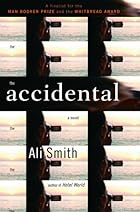
Laura's Review - The Accidental, by Ali Smith
Eve and Michael Smart, and their children Magnus and Astrid, rent a house in Norfolk for the summer, hoping to escape the stress of everyday London life. One day a young woman named Amber appears on their doorstep, and everyone is so caught up in their own cares, each assumes she is known to one of the others. Astrid thinks she's a friend of Eve's; Eve thinks she's one of Michael's university students, etc. Amber stays for dinner, and spends the night, albeit in her car. Time passes and before you know it, Amber is firmly entrenched in their lives. She's a dubious role model and mentor to 12-year-old Amber, the object of 17-year-old Magnus' passion, and the one woman Michael wants but can't manage to seduce. Amber also becomes privy to several deep family secrets, some shared with her directly and others obtained through her powers of reason.It's all very strange, because she's not particularly likeable. You'd think one of the parents would kick her out, but every member of the family is so locked inside their own head that no one understands the effect she's having on them collectively. As Amber inserts herself into the family, she shares remarkably little about herself, and yet manages to get everyone else to let their guard down. Each family member has the chance to tell their version of the story, taking turns as narrator, which enables the reader to get just as deep into each person's psyche as Amber does. Ali Smith used very different writing styles and techniques for each character, underscoring the differences between family members. On the other hand, Amber's chapters are decidedly sparse, so as readers our understanding of her is just as limited as the family's.
I was initially intrigued by Smith's quirky writing, but eventually tired of it. The story seemed about equal parts positive and creepy. Only when the family returns to London does the full impact of Amber's visit become clear, and the whole thing struck me as quite creepy indeed. And while this book gave me some interesting thoughts to ponder, I was left wishing some of the family relationships and related themes were further developed.
Cross-posted from my blog
Sunday, February 12, 2012
Introducing Kate
Hello, friends.
I'm pleased to be included in The Complete Booker. I've been steadily reading through Booker winners and nominees for a few years and am glad to be able to share thoughts and reviews with others. As a current full-time graduate student in archaeology, I'm also grateful to Laura for having and maintaining this site for all of us to use!
I am an avid reader across many genres (though I tend to dislike postcolonial fiction) and my reviews range from longer, ponderous pieces to short, casual "thoughts on" posts. Outside of my dissertation research I also enjoy hiking, travelling, good coffee, interesting art, museums, dancing, and I'm taking up knitting again after many years away. I am an expat American living and teaching in a small English town, and relishing the cultural difference.
I won't bore you all with reposting all of my previous Booker posts from my blog, What Kate's Reading, but will link for you to peruse as you choose:
For my reading here on out I'll either post a current link to my blog or the full review itself. Does anyone have any opinion on that? I don't have any Bookers in the to be read pile as yet, but as my reading is highly dependent on my local library, I have no doubt one will come up soon enough.
Thanks again, and I look forward to being a part of this site.
I'm pleased to be included in The Complete Booker. I've been steadily reading through Booker winners and nominees for a few years and am glad to be able to share thoughts and reviews with others. As a current full-time graduate student in archaeology, I'm also grateful to Laura for having and maintaining this site for all of us to use!
I am an avid reader across many genres (though I tend to dislike postcolonial fiction) and my reviews range from longer, ponderous pieces to short, casual "thoughts on" posts. Outside of my dissertation research I also enjoy hiking, travelling, good coffee, interesting art, museums, dancing, and I'm taking up knitting again after many years away. I am an expat American living and teaching in a small English town, and relishing the cultural difference.
I won't bore you all with reposting all of my previous Booker posts from my blog, What Kate's Reading, but will link for you to peruse as you choose:
- Mister Pip
- The White Tiger
- The Old Devils
- In a Free State (which is less of a review than a critique of the author's recent statements about women authors)
- Netherland
- A Short History of Tractors in Ukrainian
- Master Georgie
- The Sisters Brothers
- Never Let Me Go
- Notes on a Scandal
- Atonement
- On Beauty
- Restoration
For my reading here on out I'll either post a current link to my blog or the full review itself. Does anyone have any opinion on that? I don't have any Bookers in the to be read pile as yet, but as my reading is highly dependent on my local library, I have no doubt one will come up soon enough.
Thanks again, and I look forward to being a part of this site.
Tuesday, November 22, 2011
Athena K's Review - A Long Long Way
It is fitting that my copy of Sebastian Barry's A Long Long Way contains quoted praise from J.M. Coetzee, whose novel Disgrace had me impressed and appalled (appreciative of the mastery and cringing from the subject) in a way similar to my reaction to this novel. A Long Long Way resonates with me - days after putting it down I can't get these images out of my head. Unfortunately, those images are scenes of gruesome death in the trenches during World War I (not exactly my favorite). But while I won't be wanting to revisit the topic for a while, I have to admit this was a masterful book, and I'm disappointed that it lost out to John Banville's snooze The Sea for the 2005 Booker.
Barry begins with a sympathetic and complex character, Willie Dunne, who takes the reader on a journey through the emotional landscape of war: terror, pain, loss and horror, yes, but also camaraderie, nationalism, familial love, and hope. But Barry's true gift is in describing the horrors of the war with gorgeous, poetic language. I especially admire his descriptions of the first chlorine gas attack ("it was the force of something they did not know that drove them shoving and gasping away from that long, long monster with yellow skin"); the awful thick mud encountered in the trenches, and the shattering cold of a winter on the front lines. These moments of description overcame my general aversion to war novels to the point where I can actually picture myself re-reading this book.
Willie Dunne experiences the worst of the war: the piss and shit and blood and guts and tears and panic of the Irish soldiers in Belgium and at home. My Irish history is a little rusty, so I needed to read up on the the uprising of 1916. But a detailed knowledge was not necessary to understand the passion and tragedy of their situation. Barry successfully made me feel emotional about an unexpected subject, and painted a vivid portrait that took me somewhat reluctantly into the trenches. It was deeply moving, and perhaps even scarring. But recommended.
Friday, September 5, 2008
Jackie's review of 'The Accidental' by Ali Smith

The book started off quite promisingly, with the meandering thoughts of a 12 year old girl. The writing style was very unusual, but I found it amusing, and although some of the thoughts were a bit too profound for a 12 year old, overall I found it quite convincing. The book continued quite well, with the guilty thoughts of her older brother, but then it went downhill with the introduction of Amber, a stranger introduced into the household. I found her character extremely annoying, and ultimately pointless.
The reader is then confronted with several chapters of poetry. This is just weird, unnecessary, and it feels as though the author is just trying to be too clever.
It doesn’t improve. The plot just disappears, the characters become more annoying, and the stream of conscious thought becomes monotonous and dull.
Avoid it if you can.
2 out of 5 stars
The reader is then confronted with several chapters of poetry. This is just weird, unnecessary, and it feels as though the author is just trying to be too clever.
It doesn’t improve. The plot just disappears, the characters become more annoying, and the stream of conscious thought becomes monotonous and dull.
Avoid it if you can.
2 out of 5 stars
Wednesday, April 23, 2008
Trevor's Review of Barnes's Arthur and George
I couldn't decide whether this book fell under the "loved it" (four stars) or "it was amazing" (five stars) category. I finally settled on "loved it" but only because I want to try (try) to keep my "it was amazing" books to an exclusive few. However, I must say that I was amazed by the book.
The story was wonderful. It is about Arthur Conan Doyle, the creator of Sherlock Holmes, and George Edalji, a solicitor wrongly convicted of an ugly crime. The first part of the book deals with Doyle's and Edalji's youths. They did not know each other, so there is no interaction, yet Barnes is able to keep both lines going with equal intrigue. We see how Edalji nestles down into a quiet, private life while Doyle increasingly expands his sphere of influence. The book really comes together when Doyle offers to solve Edalji's crime. Interestingly, Doyle's object is noble, but his own motives are not. Even while he respects Edalji and wants to see him freed, Doyle is still fairly condescending. To me, this is Barnes doing a great job keeping true to Victorian mind.
I especially enjoyed that this book is based on true events. The letters quotes come from actual letters. I found the psuedo-biography fun and enlightening. Though the book is fiction, I'm sure that some of how Barnes characterizations were accurate, and his depiction of Edalji's legal mind and of Doyle's Victorian mind were enlightening and entertaining. I loved how Edalji would analyze things thoroughly and then cross examine himself. It didn't get in the way of the story for me to have the characters constantly feeling strongly one way only to then convince themselves that they were wrong. On the contrary, that is one of the reasons I loved this book.
Barnes writing was smooth and effortless to read. At the same time it was penetrating, and he could articulate feelings and contradictions with clarity. Personally, I think this book was better than Banville's The Sea and Ishiguro's Never Let Me Go.
4 stars out of 5
The story was wonderful. It is about Arthur Conan Doyle, the creator of Sherlock Holmes, and George Edalji, a solicitor wrongly convicted of an ugly crime. The first part of the book deals with Doyle's and Edalji's youths. They did not know each other, so there is no interaction, yet Barnes is able to keep both lines going with equal intrigue. We see how Edalji nestles down into a quiet, private life while Doyle increasingly expands his sphere of influence. The book really comes together when Doyle offers to solve Edalji's crime. Interestingly, Doyle's object is noble, but his own motives are not. Even while he respects Edalji and wants to see him freed, Doyle is still fairly condescending. To me, this is Barnes doing a great job keeping true to Victorian mind.
I especially enjoyed that this book is based on true events. The letters quotes come from actual letters. I found the psuedo-biography fun and enlightening. Though the book is fiction, I'm sure that some of how Barnes characterizations were accurate, and his depiction of Edalji's legal mind and of Doyle's Victorian mind were enlightening and entertaining. I loved how Edalji would analyze things thoroughly and then cross examine himself. It didn't get in the way of the story for me to have the characters constantly feeling strongly one way only to then convince themselves that they were wrong. On the contrary, that is one of the reasons I loved this book.
Barnes writing was smooth and effortless to read. At the same time it was penetrating, and he could articulate feelings and contradictions with clarity. Personally, I think this book was better than Banville's The Sea and Ishiguro's Never Let Me Go.
4 stars out of 5
Trevor's Review of Ishiguro's Never Let Me Go
I was disappointed in Never Let Me Go. I don't think it was one of the best books of 2005 nor was it quite what I expected from Ishiguro, not that I expect or want him to comply to my wishes.
Here is a compelling story about a unique group of friends who went to Hailsham, an exclusive boarding school, together. Now, several years later, looking back on that experience before they entered their vocation--a vocation that was chosen for them, a vocation, in fact, that they were in a way bred for. In their youth they were innocent. They had emotions that they wanted to express, but such expression was seen as unsafe by the authorities. Years later, having lost that innocence and knowing they did not have much time left together, they try to take the measure of their lives.
As always, Ishiguro's writing style is subtle and adept. However, I didn't think that made this book that profound. Sure, I liked discovering what the story was actually about slowly--it made the book all the more real and showed Ishiguro's confidence and supreme control over the plot. I just didn't really like the story. And while their were moments of heartache, where I supremely felt for the characters, in the end I did not truly sympathize with them. Where in The Remains of the Day the themes emerged out of the characters' interactions, in this book the themes seem to be at the forefront, the characters merely vessles to explore the themes. Consequently, even the themes felt less true. I am sad I do not care about this book's Kathy nearly as much as I do about The Remains of the Day's Stevens. In the end, this book definitely shows the Ishiguro's immense skill at subtle evocation--his skill is still breathtaking.
3 stars out of 5.
Here is a compelling story about a unique group of friends who went to Hailsham, an exclusive boarding school, together. Now, several years later, looking back on that experience before they entered their vocation--a vocation that was chosen for them, a vocation, in fact, that they were in a way bred for. In their youth they were innocent. They had emotions that they wanted to express, but such expression was seen as unsafe by the authorities. Years later, having lost that innocence and knowing they did not have much time left together, they try to take the measure of their lives.
As always, Ishiguro's writing style is subtle and adept. However, I didn't think that made this book that profound. Sure, I liked discovering what the story was actually about slowly--it made the book all the more real and showed Ishiguro's confidence and supreme control over the plot. I just didn't really like the story. And while their were moments of heartache, where I supremely felt for the characters, in the end I did not truly sympathize with them. Where in The Remains of the Day the themes emerged out of the characters' interactions, in this book the themes seem to be at the forefront, the characters merely vessles to explore the themes. Consequently, even the themes felt less true. I am sad I do not care about this book's Kathy nearly as much as I do about The Remains of the Day's Stevens. In the end, this book definitely shows the Ishiguro's immense skill at subtle evocation--his skill is still breathtaking.
3 stars out of 5.
Tuesday, December 11, 2007
Laura's Progress - Booker Shortlists read in 2007 or before
I became a Booker Prize devotee when I lived in England from 2000-2004. The short- and long-lists were a primary source for my TBR pile. I really enjoyed becoming acquainted with a number of excellent authors, and have continued to follow the prize every year. Reviews are available for the three that I read in 2007:
2007
2007
- The Reluctant Fundamentalist, by Mohsin Hamid - review
- Arthur & George, by Julian Barnes - review
- Never Let me Go, by Kazuo Ishiguro - review
- On Beauty, by Zadie Smith
2004
- Cloud Atlas, by David Mitchell - review
- Notes on a Scandal, by Zoe Heller
- Brick Lane, by Monica Ali
- Story of Lucy Gault, by William Trevor
- Unless, by Carol Shields
- The Dark Room, by Rachel Seiffert
- Atonement, by Ian MacEwan
- The Hiding Place, by Trezzo Azzopardi
- When we Were Orphans, by Kazuo Ishiguro
- English Passengers, by Matthew Kneale
- The Stone Diaries, by Carol Shields
Monday, December 10, 2007
Arthur and George - Wendy's Review
Julian Barnes has crafted an imaginative, compellingly readable 'whodunnit' that keeps the reader compulsively turning the pages.Based on the life and work of Sir Arthur Conan Boyle, it is a tale of two men - George and Arthur - who seem to be living worlds apart, but whose paths cross when a mystery surfaces. The novel explores larger themes of racism and morality, but is driven by excellent story telling and Barnes' gift of creating character.
I read this for a book club read and also because it was listed as a 2006 New York Times Notable. I am happy I picked it up. If you enjoy evocative novels which spin a good yarn, you will love this book.
Recommended; 4/5.
Subscribe to:
Posts (Atom)