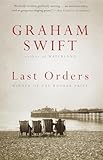
Showing posts with label 1996 - Last Orders. Show all posts

Friday, February 3, 2012

J.G.'s Review - Last Orders


I didn't expect to like this book so much. Somehow it became linked in my mind with The Old Devils, which I really didn't enjoy. Maybe it was the barroom association? Anyway, I approached my reading as though it was a flu shot: with a robust sense of taking my medicine and getting it over with. (Check off another Booker Prize winner for me!)

The story is a conglomerate of the voices and perspectives of a group of men who have been friends and neighbors for many years, through coming of age in World War II, returning to civilian lives, and establishing careers and families. While each has had his own story--Lenny the produce vendor, Vic the funeral director, Ray the insurance man and proverbially lucky horseplayer--their lives have been lived collectively, too. Now they embark on a road trip to perform a task that inaugurates a new phase in their shared lives: scattering the ashes of Jack the butcher, the first of their group to die. They are joined by Jack's adopted son Vince, who adds plenty of resentment to the emotional mix.

Each small chapter of this book is told by a different member of the group, as they progress on their journey to the sea. A few other female relatives and Jack's wife Amy also chime in at times, although they are not along for the ride. Amy has declined to participate in the scattering (and technically Jack's "last orders" didn't say who should do the scattering), but as the story unfolds, Amy's perspective becomes especially important, so it's appropriate that she also have her say.

Along the journey, amid stops at the pub ("last orders" also means "last call"), gallows humor, unexpected detours, and even a fistfight, lots of secrets are revealed. The details of unusual family ties, adultery, marital conflicts, money troubles, coincidences, and true motivations all come out as the characters alternate interior monologues and conversations with each other. They are at times evasive, at times filled with denial, and at times groping toward honesty and insight. Although it's apparent to the reader that they have muddled their lives, they don't seem to grasp that themselves. They just muddle on.

The characters' voices did not seem entirely distinct to me, but their perspectives always were. The narrative's time frames flow from the present journey to past events and back again, in anything but chronological order. Only the reader can fully see how the pieces all fit together. It's a shifting mosaic, but somehow it seems more elegant than choppy. Generally I dislike this kind of piecemeal technique, but here, it works. By the end, the love and friendship between these flawed men and their dedication to Jack's final request are surprisingly moving. Maybe minor, maybe tarnished, but that's all they've got.

Excerpt (Ray remembers visiting Jack in the hospital):

He said, "So now I know, Raysy."

It was a full day and a half after the operation that wasn't no operation, so he wasn't groggy and slow and confused any more. Sharp and clear as I've ever seen him, sitting up there in that little white smock thing, with the extra tubes going in, some round the back now. It seemed like every day they rigged up another tube. . . .

But he was sitting up, straight and steady. I thought, It's like he's having his portrait done, his last portrait, no flattering, no prettying, and no one knows how long it will take. Two weeks, three. Nothing to do but sit still and be who you are.

Note: this review is also posted on my blog, Hotchpot Cafe.

Thursday, October 6, 2011

Athena K's Review - Last Orders

Last Orders is a solidly good book.  I read somewhere that all good Booker books create their own language to draw you into their world.  The unique language is what elevated Last Orders.

The story is a bit depressing (so you know I liked it).  Jack has died, and his best friends and adopted son are tasked with the job of fulfilling his final wishes or "last orders."  Bonus: this involves a road trip!   On the way, the characters (and absent wife) reminisce about their time and experiences together - involving World War II, marriage, children, and a changing and modernizing world.  Each character takes turns narrating short, succinct chapters with pithy reveals.

I have not read many books set in working class mid-century London, and this was a learning experience for me.  Motors and cars represent the modern world (but Ray is still obsessed with horses).  Vincey, Jack's adopted son abandons the family business for a new future in cars.  But as with any future, this one isn't all its cracked up to be. Perhaps like the cars, the narration moves too quickly at times - I had to put the book down after some passages to think on the revelations that just occurred.

More interesting and accessible to me was the role and position of the women in this book who, although mostly absent, seem to drive the character and motive of each of the narrators.  Ray, the prime narrator has the most interesting relationships with women.  His daughter's struggle to find independence, his wife's failure to do the same, and his complicated relationship with Amy were my favorite parts by far.  But each of the narrators struggles with the male/female relationship, especially as husband/wife and father/daughter.

The only reason this doesn't earn tippy-top reviews from me is that it took me a longer time than normal to sort the characters out at the beginning, and I think Graham Swift  used up his good surprises in the middle of the book leaving me a bit disappointed at the end.  But it was a worthy read and winner.

Sunday, May 23, 2010

Matthew's Review - Last Orders - 1996

Last Orders, by Graham Swift, received a bit of flak from the critics over its use of the structure from Faulkner's masterpiece As I Lay Dying. To me, that doesn't seem fair considering this novel stands on its own, and familiarity with Faulkner's work is absolutely not required.

Jack Dodds has passed away from cancer, and his final request, to his best friends, most of them war veterans, is to have his ashes scattered into the sea. His three friends and his adopted son undertake a roadtrip to Margate from London to do this. Along the way, they reminisce and celebrate the good times and the bad.

The Faulkner connection is that each chapter is first person stream of consciousness narration, getting right inside the head of the specific narrator. In the modernist sense, this means it goes backwards and forwards in chronology, which can make the first thirty pages or so confusing, as the reader's hand isn't held by the author.

Luckily, Swift makes each character real and breathing. You never doubt the authenticity of them for a moment. This sustains the emotional realism of the novel. It's very multifaceted, with numerous asides and flashbacks detailing everybody's lives, never in a painstaking or compulsive manner, always organic to the overall story.

If there was a criticism to be leveled at this book, it's that it feels slight, or airy. When Swift reaches for moments of thematic depth, the best he can do is a statement on the benefits of eternal friendship, or a platitude of a similar nature. There's no sweeping epic theme of death like which pervades the spiritual inspiration As I Lay Dying. Rather, Last Orders is a simple novel of friendship. This isn't necessarily bad, just slight.

Last Orders is a good novel, filled with realistic characters and an excellent use of stream-of-consciousness narration. But I would not say that this novel can be elevated to the heights of Faulkner or Woolf. It's better than what sits on most bookstore shelves, anyway.

Sunday, February 7, 2010

Lorraine's Review - Last Orders - 1996

I posted my review of Last Orders on my blog today. You can read it here.

Marieke's review - Last Orders by Graham Swift

Last Orders by Graham Swift

Some books need to settle a bit before I can write about them. Graham Swift's Last Orders is one of these -- a quiet story of love and loss, the meaning of family, and the unbreakable ties of friendship.

I love the way the story is structured on a day’s journey made by four old friends to scatter the ashes of their recently deceased pal, Jack. As their journey progresses, we get glimpses into the private memories of each character as they revisit moments from their long acquaintance with Jack and with each other.

Strands of emotion connect each character in an invisible web, with Jack surely at the center.

Animosity, admiration, loneliness and jealousy seep out of every word, every gesture, every exchange.

This is a story with more remaining unspoken than is spoken. That’s what I mean by ‘quiet’. But the depth of feeling conveyed is notable: Vince’s resentment toward his father, Ray’s flame for Amy, Lenny’s anger and distrust, Vic’s deep respect for Jack.

Swift’s short chapters sketch the scenes and characters quickly and efficiently but not haphazardly. The effect is like watching a master artist create a magnificent painting with just a few strokes.

My rating: 4 of 5 stars.

You can read my original review here.

Wednesday, January 7, 2009

1996 - Last Orders by Graham Swift

Last Orders is a lovely book. It won the Booker Prize in 1996, and was made into a terrific film with Michael Caine as Jack.

It's a deceptively simple story. Four blokes take a day trip to Margate Pier to spread the ashes of their mate, Jack, to the sea. Multiple narrators carry the story through flashbacks to the past and commentary on present events, gradually revealing a complex network of relationships, misunderstandings and betrayals, a fragile web held together by grudging affection and respect.

There's Ray, an insurance clerk and punter: Lucky Ray Johnson who's had an affair with Jack's wife; there's Vic, an undertaker whose business is across the road from Jack's butcher shop and there's Lenny, a fruit-and-veg stallholder whose daughter was 'knocked up' by Vince. Vince is Jack and Amy's foster child, brought up as their own when his family was killed by a doodle-bug in the war. He's a substitute for the child-that-never-was, June, Amy and Jack's grossly retarded daughter. Amy wastes fifty years of her life visiting this child who is incapable of responding to her and she can't forgive Jack because he would rather June were dead.

In an interview, Swift says that his characters are undeducated, inarticulate Londoners who have feelings they can't express. I think it's true they're pretty hopeless at expressing things, and there's a gulf between thought and words, but also (as we thought when The Spouse and I saw the film) it was as much a problem of males being unable to express their feelings as much as a lack of education and language. Amy is best at saying what she thinks and feels...

The narrators are not meant to be trusted. Ray, for example, isn't always honest with himself, and neither is Amy. She uses visiting June in the home as an excuse for her affair with Ray to stop, when the real reason is partly that Vince is coming back from military service in Aden and partly that she's realised that she really does love Jack. Swift not only creates doubt about his characters in this way but also through showing that each of them sees the world through their own perspective and they don't always have all the facts. Vic, for example, sees Ray and Amy together - he never says anything about this to anyone and jumps to the conclusion that the affair has been going on for years.

The damage done by stubbornness is a strong theme in this novel. Amy steadfastly refuses to accept Jack's feelings about June; he stubbornly clings onto the hope that Vince will be the son he never had so that the business can become Dodds & Son. Lenny ruins his daughter's life by insisting that she has an abortion and then when things go awry he stubbornly washes his hands of her. For years and years Ray fails to communicate with his daughter in Australia because he doesn't know how to tell her about crucial events that affect her life. These 'invisible people' in the novel play an important role in the characterisation of the others, and the plot.

What binds the men together is that they are 'drinking partners'. Swift portrays tolerance in male friendship as a kind of moral blindness, as when they conspire 'not to notice' that Ray has been sleeping with his mate's wife. Some people see these characters as male stereotypes - Ray blathering on about mateship in the army and Vince being a petrol-head - but I don't think so. Initial impressions are subverted as different layers and perspectives emerge. Vince, for example, isn't a petrol-head - he's used the army to learn a trade to get into business and achieve social mobility. He's more interested in exploiting the role of the car as a status symbol than he is in performance machines; he might just as easily be selling cashmere or diamonds.

Is Amy a stereotype because we only see her through the men's eyes? It's only her bloody-minded devotion to poor June that casts her so stolidly in the role of 'mother'. She doesn't do much mothering of Vince, not even when he was little. She makes unexpected decisions as the novel reaches its conclusion, and the question of her relationship with Ray remains unresolved at the end. Stereotypes don't lend themselves to ambiguity in this way, and I think Swift's characterisation results in memorable personalities - quite an achievement considering how the reader has to piece things together. Just as the characters do.

I finished reading and journalled this book on 3.5.2003.
Lisa Hill, ANZ LitLovers

Thursday, October 16, 2008

Laura's Review - Last Orders


Last Orders
Graham Swift
295 pages

In this Booker prize-winning novel, four men spend a day travelling from London to the coast to scatter the ashes of Jack Dodds, as he requested just before his death. Three of the men -- Ray, Lenny, and Vic -- have been friends with Jack for most of their adult life, living in the same working-class community, and earning their living in local businesses. The fourth, Vince, is Jack's son. Thoughts, feelings, and history are revealed through short chapters, each told from one character's point of view. Each man has experienced love, loss, friendship, disappointment, and varying degrees of prosperity. Their lives are intertwined, sometimes in ways that the characters are unaware of individually. For the most part, these men swagger and boast while inside, they are full of pain. There are a few women in this book, but they are minor characters. Jack's wife, Amy, is portrayed in the most detail. I felt sorry for her; she was trapped in a less-than-satisfying marriage, with family obligations that Jack refused to share.

Swift has a way of evoking a time and place, and the characters seemed like real people. Their stories were moving in parts. I'm a bit surprised this won the Booker Prize, as it doesn't seem to compare to other winners I've read, but it's a passable if somewhat melancholy read. ( )

My original review can be found here.

Tuesday, September 9, 2008

Last Orders

This Booker Prize winning book by Graham Swift tells of four men on a day trip to scatter their friend's ashes to the sea. The chapters are short and the narratives switches with each chapter. Most are told by Ray, the closest friend of the dead man Jack Dodds. There are numerous flashbacks revealing the lives of all the men and a couple of others in their lives. The dialogue is quite sharp and well written; Swift has a knack for characterisation. The language and changing perspectives makes it evocative. I sometimes managed to feel the bitterness and the anger that some of the characters do when they narrate. It is very English; all the characters have a working class background and there is something very stylistic and true about the way he writes about their livelihood. If anything, it feels sincere even if real working class Londoners do not all the issues these characters did. I liked the book for the most part, but it got bit depressing the further you went. The flashbacks reveal missed opportunities, unsaid things, wrong choices, bad luck, and estranged relationships. The ending, as with life, is open ended. Not a very uplifting read, but Swift does have a good voice throughout the story.

For a review of the film as well, go to aquatique.net.