Showing posts with label Karen (Booker Talk). Show all posts

Saturday, March 29, 2014

Unexploded by Alison Macleod - 2013 Longlist


Eight months after Britain declares war on German, the people of Brighton anxiously prepare for a rumoured Nazi invasion. The town's piers are dismantled and barbed wire goes up on the beach. Soon vegetable seedlings will replace the flower displays in the parks and the lights of the fun fair will be dimmed. Already the racecourse has been transformed into an internment camp for whose people deemed to be 'suspicious'.  such as Otto Gottlieb, a German-Jewish artist whose work featured in the Nazi exhibition of "degenerate art".

In the Beaumont household, the preparations ignite underlying tensions. Geoffrey Beaumont is a banker charged with a secret mission to secure the future of the country's currency by removing it to an undisclosed location, leaving his wife Evelyn and eight year old son alone to face the invaders. The only preparations he makes on their behalf involve a stack of cash and an envelope containing two cyanide pills buried  in the garden, a contingency plan that in Evelyn's eyes, amounts to a betrayal. The resulting tension between them escalates when Evelyn takes more than a close interest in Otto Gottleib and questions the treatment of the internees at the camp.

It's easy to see why Unexploded was long-listed for the 2013 Man Booker Prize. Macleod delivers a very persuadable sense of the period, rich in detail and atmosphere. Even though so much has been written about the lives of ordinary people at this point in Britain's history; the anxiety of an unknown enemy, the constant rumours, the day to day trials of food shortages, the narrative often has a fresh feel.  In one extended passage she describes how it would feel to be on the receiving end of a bomb attack.
You are lifted from your bed even before you hear the blast..... You wake, unable to understand why heaps of gravel and brick dust are being shovelled over you at speed. You stumble outside for air, but even here the day is thick with dust, soot and - you can't make sense of it - a blizzard of feathers.
The immediacy of the present-tense approach coupled with her use of imagery made this one of the most memorable passages in the book for me.

I also enjoyed her characterisation of the Beaumont's son Phillip. As an only child his loneliness leads him to become friends with boys who would not be out of place in Lord of the Flies, to hide in corners listening illicitly to the radio, and to betrayal. Where the adults are simply frightened by the prospect of Hitler's arrival, Philip's reaction is more complex. It starts as a game, an amusing diversion, but then things happen that although he doesn't comprehend fully, he still recognises as disturbing and wrong.

His story is suggestive of a theme in the novel about the way the war acts as a catalyst, igniting elements that have until now lain idle such as the incompatibility between Evelyn and her husband and the anti-Semitic attitudes held by sections of the British population. In essence this is a novel that shows a society at a turning point:
Change was creeping under the door and through the windows of their home, persistent as gas … It was gathering over the house in spite of the purity of the day's rinsed blue sky. It was spiralling down the flue. At night as they slept, it would settle over their hearts.
A good story; well-written prose; lots of simmering tension, strong characterisation and meticulous attention to detail: it would be hard to find much about this book not to enjoy.

EndNotes
Unexploded was published by Hamish Hamilton in 2013.
Alison MacLeod is a professor of contemporary fiction at the University of Chichester in the UK. Raised in Canada she has lived in England since the 1980s. This is her  third novel.

This review is crossposted from BookerTalk.com

Wednesday, February 5, 2014

Heat and Dust by Ruth Prawer Jhabvala - 1975 winner


I opened Heat and Dust hoping that Ruth Prawer Jhabvala's  1975 Man Booker Prize winning novel would provide a fresh take on a theme explored by Paul Scott in The Jewel in the Crown (the first  book in his Raj Quartet series) and of course that classic of the cultural divide; E M Forster's A Passage to India.
In many of the tributes written about Jhabvala on her death in April 2013, she was described as a "cold-eyed observer of people and places" and a writer whose status as a non-native inhabitant meant she could view the country with unemotional detachment.
Detached and unemotional are indeed good descriptions for this tale of the cultural divide between colonisers and the natives they govern and of those who try to break free from conventions and restrictions.
The story is that of an un-named woman who travels to India in an attempt to unravel the mystery of her step grandmother Olivia during the rule of the British in the 1920s.  She deciphers the story mainly from letters Olivia wrote to her sister and by visiting places where her grandmother lived.  Gradually we learn that Olivia's story is one of disgrace and scandal Feeling smothered by the restrictions of the British way of life in India, she fell under the spell of a Nawab (an Indian prince) for whom she abandoned her husband . Fifty years later her grand-daughter, though more independent and less naive than Olivia similarly becomes seduced by India. She too crosses the divide.
The novel has none of the tension found in Scott's novel nor does it have the  subtleties of A Passage to India. It doesn't so much end as simply peters out inconclusively leaving me feeling decidedly underwhelmed. It's not what I expect of a prize-winning novel.

Sunday, December 15, 2013

Harvest by Jim Crace - 2013 shortlist

…. rain or shine, the earth abides, the land endures, the soil will persevere for ever and a day.

That quote from Jim Crace's latest book Harvest might lull you into thinking this novel is a homage to the timeless quality oHarvestf the countryside.  It isn't any more than it is a sentimentalised evocation of England's green and pleasant land or even a tribute to the symbiotic relationship between the land and the generations of dwellers for whom the land has provided a means of existence.
Instead it's a deeply thoughtful story that examines the human consequences of a rupture in a  traditional way of life resulting from a pursuit of "Profit, Progress, Enterprise".
The setting is a small rural English community known simply as The Village where life follows the ceaseless cycle of sowing,planting and harvesting  required to eke out even the barest of subsistence living.  The Village exists in a bubble where the regular routine is seldom troubled by anything beyond the ancient oaks and dry stone walls that mark the reaches of the settlement.
Even if the inhabitants are not fully aware of it, this is a way of life that is threatened. As the novel opens, smoke wisps are still rising from the ruins of a stable at the local manor house,  – the result, the villagers believe, of an arson attack. Barely have they recovered from that shock when there is a further signal of a disturbing nature.  New comers have arrived, taking advantage of a law that gives them the right to settle within the village's boundaries as long as they can put up a rudimentary shelter and send up smoke before they are caught. The events become conflated in the minds of the villagers fearful that the year's disastrous harvest will have to stretch even further.
What the villagers do not know is that there is an more profound change on the horizon. The manor lord Master Kent has always taken a paternalistic attitude towards his tenant but now his claim to the estate has been revoked.  The new lord intends to enclose all the fields, turning them from crop growing to the more profitable venture of sheep grazing. The villagers who have tended these fields for generations will be forced out when the land they farm in common is enclosed for sheep. When he arrives to take stock of his new estate complete with his entourage of strong- arm men, aggression, violence and death soon ensue.
Our guide to these events is one Walter Thirsk, an old boyhood friend and former servant of Master Kent. Although he's lived in the village for a dozen years or so after marrying one of the villagers, they still view him as an outsider. Walter has a deep and abiding affection for the fields and oaks around him, viewing them as a form of Eden.  But he has no illusions about the way nature can be inflexible and stern, presenting hardships for those who make their living from the land. He is a realist who knows that the world around him is changing and that it will be to the detriment of his community. For all the new master's talk of a new order "to all our advantages" and the prospect of a life without hard work and where uncertain grain harvests will be swapped for the predictability of sheep farming,  The effects of enclosure for him will be  "to throw a halter around our neck."
Walter sees the economic and human consequences of enclosure. But he also sees it as a rupture of man's connection to his past.
We're used to looking out and seeing what's preceded us, and what will also outlive us. ... Those woods that linked us to eternity will be removed... That grizzled oak which we believe is so old it must have come from Eden to our fields will be felled and routed out. That drystone wall put up before our grandpa's time .... will be brought down entirely ....until there is no trace of it. We'll look across these fields and say, 'This land is so much younger than ourselves."
Crace relates this story in language that at times borders on poetry. There is a close attention to detail - we get many names of hedgerow plants for example which might enable some experts to actually pinpoint the location or even the era. And some wonderfully evocative phrases such as the Turd and Turf,  an area which does double duty as both latrine and burial ground.  Crace has a real feel for the landscape - its shape, its sounds and its smells  - but even more powerfully rendered his is appreciation for man's relation to the land.
My Verdict
A superb novel, one of the best I've read all year. Immediately on finishing it, I wanted to start it all over again. I read it before the judges announced it was not the winner of the 2013 Man Booker Prize. There's no justice in this world!

Tuesday, October 29, 2013

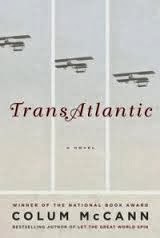
Transatlantic by Column McCann - 2013 Longlist


Colum McCann opened his award-winning novel Let the Great World Spin with a dramatic, real-world event  — Philippe Petit's 1974 high-wire walk between the newly built Twin Towers of New York.  In similar vein he opens TransAtlantic with another astonishing feat — the first nonstop transatlantic flight by the British airmen Alcock and Brown shortly after the end of World War 1.

In both novels, these daring acts demonstrate man's relentless desire to challenge and push through the boundaries of what is possible. They also serve as narrative anchors for a McCann's multi-stranded narrative about individuals whose lives overlap and connect during some 150 years of American-Irish history.

McCann brings together three real-life stories: Alcock and Brown and their ground-breaking flight; a visit to to Ireland in 1845 by the antislavery activist Frederick Douglass and the diplomatic attempts by Senator George Mitchell to broker the 1998 Good Friday peace settlement in Northern Ireland.  The novel's final strand introduces four generations of women whose fictitious lives intersect with those of the real-life characters over the centuries. Via these multiple narratives we go back in time to an Ireland on the verge of famine and to the American Civil War and then come forwards to the 1998 Good Friday Agreement and the demise of the Celtic Tiger.

It's an ambitious approach structurally and thematically. McCann's story is essentially about the complex connections between two nations separated but yet united by the same stretch of water. Into this he weaves ideas about the way ordinary lives  are touched by great moments in history.

Given the scope and scale of his ambition, he could perhaps be forgiven a few misses. TransAtlantic begins on a strong note with the recreation of Alcock and Brown's flight through snow and fog aided only by some rudimentary navigation systems.
Three thousand feet above the sea. In the cloud their balance is shot to hell. No sense of up. No down. Two thousand five hundred. Two thousand. The slap of rain and wind in their faces. The machine shudders.  ... Their bodies are thrown back against the seats. What they need is a line of sky or sea. A visual. But there is nothing but thick, grey cloud... No horizon, no centre, no edge.
The next few sections sadly don't live up to that opening promise. The 1845 famine caused by the failure of the potato crop is sketched slimly while the chapters set during the American Civil War are dealt with so slightly they don't have much impact. For me the weakest strand came with the efforts to bring about some form of lasting settlement between the British government and the paramilitary forces in North Ireland.  Diplomacy by its nature doesn't lend itself that well to the dramatic but the portrayal of Senator George Mitchell sucks even more life from the narrative.  We get no strong insight into his character beyond the fact he is tired of the painfully slow progress of talks and would much rather be at home with his family instead of criss-crossing the ocean.

Nor are these middle sections helped by McCann's terse prose which often contains verbless sentences or one-sentence paragraphs where the words come forth like a machine gun.

You might be tempted during these sections to give up on the book.

I urge you to resist the temptation.

McCann has saved his best for the final chapters.

This is where he switches to the remaining female members of his fiction family.  The particular focus is on Hannah Carson, the great grand-daughter of a young maid who was so inspired by hearing Douglass talk of freedom and equality, that she crossed the Atlantic to make a new life for herself in America. Her descendants eventually returned to the motherland.

Now aged 72, Hannah lives in the family's tumbledown cottage on the shores of  a tidal lake with only her incontinent dog for company.  She feels not only the pressure from a bank that demands she sells so she can clear her overdraft, but also the weight of her country's history and its traumatic effect on her own family. It's quite the most powerful and moving part of the whole novel.

Originally posted at www.bookertalk.com

Wednesday, September 25, 2013

2012 Shortlist The Lighthouse by Alison Moore


Alison Moore's debut novel The Lighthouse is a quietly deceptive tale; one of those books that so gently wraps itself around you that you just have to keep reading even when you're not really sure where it's going.

This is not a novel that bursts forth with a big bang opening or one that contains any significant dramatic events. Instead we follow the slow trail of a middle-aged man bearing the oddly-sounding name of Futh, as he takes a solo walking holiday in the Rhineland.  Futh's idea of a good holiday is rather simple; he isn't looking for adventure but rather a 'week of good sausages and deep sleep'  that will help him recover from the recent break up of his marriage. We soon discover that his marital separation isn't anywhere as traumatic an experience as his mother's decision to abandon him as a child.

Futh is a lonely and rather hapless soul. A man who seems only half complete. He has no true friends; his father mocks his work as chemist who creates fake scents for polishes and air fresheners and his marriage is little more than a relationship of convenience.  As he tramps the paths along the Rhine each day with blistered feet and sunburnt head he recalls episodes and fragments from his life.

Futh clings to his past life with the aid of a small lighthouse-shaped perfume bottle that once belonged to his mother. He carries it with him everywhere, a talisman whose  violet scent always reminds him of his mother and the last day they enjoyed together before she abandoned him.

This small object, one of many motifs within the novel, takes on additional significance in the second strand of the book in which we meet the owners of a small hotel/bar called Hellhaus (German for ‘lighthouse’) where Futh begins and is due to end his holiday. Esther has a habit of enticing some of her male guests to sleep with her as a way of getting her taciturn husband Bernard to show an interest in her again. He does with the aid of dark threats and a heavy fist.  Poor Futh gets caught up in their tangled lives on his first night on holiday when he attracts Bernard's mistaken suspicions of an assignation with Esther. Futh leaves the establishment on the first morning blissfully unaware of the smouldering fuse he is leaving behind in this hotel and to which he will return. Although this is not a suspense novel in the traditional sense, Moore's narrative gradually notches up the tension with each step that takes Futh back to the hotel.

The Lighthouse explores the consequences of a traumatic incident in childhood; the way the past impacts the adult self.  Futh evokes our sympathy for the hopelessness and emptiness of his life and his obsession with the past, with its old wounds and childhood hurts that will always keep dragging him back and prevent him achieving from achieving happiness.

Thursday, June 20, 2013

2005 - The Sea


John Banville was the surprise winner of the Booker Prize in 2005 with his lyrical novel The Sea. Literary pundits had put their money on Julian Barnes’s Arthur and George walking away with the prize or a repeat Booker success for Kazuo Ishiguro andNever Let Me Go.
No-one was more surprised than the Banville at his success, particularly because he felt that two of his earlier books were more like the “middle-ground, middlebrow work” that he felt judges tended to choose. By contrast he considered The Sea to be more of an “art novel”. It was a comment which ruffled more than a few feathers among the literary elite.
Banville’s description of The Sea as an ‘art’ novel could be considered a strange term for a novel that relies on the well-used device of a character returning to a place that played a significant part in his earlier years. But that simplified version of the plot doesn’t to justice to a novel that is a richly textured and patterned meditation on the nature of memory and loss and of the bitter-sweet nature of first love.
In The Sea, the widowed art historian Max Morden returns to the seaside village where as a young boy on the verge of adolescence, he once spent a family holiday. It’s a trip that is at once an escape from the traumatic loss of his wife but at the same time an opportunity to confront a dramatic event that occurred during that summer seaside sojourn. The nature of that event is held back from the reader until the closing pages of the novel, not because Banville is planning a big dramatic reveal but because his real interest is the process of recollection. Morden’s odyssey into his past takes place through a series of vignettes which reveal his relationships with his father, his wife and his daughter. He recalls also the Grace family who also holidayed in the same resort and whose allure he found impossible to resist.
This is a tale that sucks you in; that takes you along meandering lanes of memory only to suddenly detour to a different time and place and then unexpectedly switch direction yet again to bring us back to the here and now. Banville has been compared to Beckett though at the 2013 Hay Festival he told the audience his favourite authors are Henry James and Georges Simenon (though not the Maigret novels he was at pains to emphasise).
Reading The Sea is a hypnotic, mesmerising experience largely due to Banville’s mastery of the atmosphere-laden sentence. The opening of the book is tantalisingly enigmatic:
They departed, the gods, on the day of the strange tide. All morning under a milky sky the waters in the bay had swelled and swelled, rising to unheard-of heights, the small waves creeping over parched sand that for years had known no wetting save for rain and lapping the very bases of the dunes. The rusted hulk of the freighter that had run aground at the far end of the bay longer ago than any of us could remember must have thought it was being granted a relaunch. I would not swim again, after that day. The seabirds mewled and swooped, unnerved, it seemed, by the spectacle of that vast bowl of water bulging like a blister, lead-blue and malignantly agleam. They looked unnaturally white, that day, those birds. The waves were depositing a fringe of soiled yellow foam along the waterline. No sail marred the high horizon. I would not swim, no, not ever again.
Someone has just walked over my grave. Someone.
With an opening like that, I was hooked. And I hope you will be too. This was the first Banville book I had read. I know it will not be the last.

Sunday, January 27, 2013

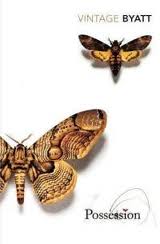
Karen's Review: Possession 1990


When a writer dies, should their private lives die with them? Or should they become the  possessions of academics and enthusiasts, to be collected, catalogued and analysed like laboratory specimens. Possession in all its manifestations — physical, spiritual, emotional — is the focus of  A S Byatt’s 1990 Booker winning novel. The more you read it, the more forms of possession become apparent: legal ownership of correspondence and creative work; obsession with words; control of one’s history;  exertion of influence; emotional disturbance.
possession
The first example comes only a few pages into the story when a postgraduate researcher uncovers some letters which hint at a secret relationship between the Victorian poets Randolph Henry Ash and Christabel LaMotte. He steals them and also hides his discovery from his boss. Instead he teams up with another academic Maud Bailey, who has devoted years to dissecting LaMotte’s work. Together they embark on a quest to discover the truth, piecing the story together from a vast array of sources, including letters, journal entries and field trips to Yorkshire and France.
But they are not the only ones in pursuit. From across the Atlantic come Professor Leonora Stern, an avid feminist who is possessed by LaMotte’s supposed lesbian tendencies and Mortimer Cropper, a scholar-collector who is hell-bent on acquiring everything once owned by Ash and shipping it to the USA.  In the background there is Cropper’s arch rival Professor James Blackadder, editor of Ash’s Complete Works who is determined to preserve all of Ash’s work in England. Ranged against them all is the determination of Ash’s widow to preserve her husband’s secret. What ensues is a cross between the tradition of the romance adventure with its battle between good and bad and the tradition of a mystery story where the characters have to follow a trail of clues to find the solution.
Byatt skillfully weaves these (or to use Byatt’s own description of ‘a piece of knitting’)  into two parallel stories. The painful Victorian love story of Ash and LaMotte, retold through their poems and letters, has its counterpoint in the present-day story of Mitchell and Bailey, whose academic partnership slowly grows into love. Their stories are intertwined so objects from one era reappear in the other — a Victorian jet brooch that Maud wears for example —  and the two pairs of lovers share similar behaviours; so Roland’s admiration for Maud’s hair parallels Ash’s fascination with LaMotte’s tresses.
A S Byatt
A S Byatt
Byatt’s versatility as a writer is evident in the multiple narrative styles found in Possession. She wrote all the poems herself, a task which required her to adopt different voices and styles for each of her Victorian poets – so successful was she that many readers apparently believed Ash and La Motte were real. Her publishers were not so convinced, fearing that  readers would find the the inclusion of so many poems too intrusive and a distraction from the mystery story.
I didn’t find them distracting so much as tedious. I’m not a fan of poetry which relies on my knowledge of myths and legends, nor do I enjoy poems which use over-blown language. Both Ash and LaMotte were guilty on both counts – many of their poems were just so dire I skipped them. Nor did I appreciate the long, and frankly often very tedious, passages in the letters between these two poets in which they discussed layers of meaning in Nordic myths. If this is how writers in their era talked to each other, I can’t imagine I’d enjoy spending much time in their company. Was Byatt making fun of them in the same way she  ridiculed the academic world for its dogged pursuit of apparently trivial knowledge? I still wasn’t sure by the time I finished reading.
I can’t say that reading Possession was a deeply enjoyable experience. I admired Byatt’s command of language and her ability to tell a story but never felt her contemporary characters came alive in the same way as the Victorians did or that the inclusion of so much poetry really enhanced the book.

Friday, December 28, 2012

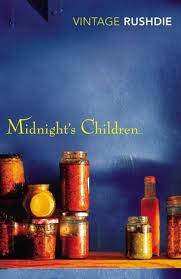
Karen's Review: Midnight's Children 1981


Bedazzled; bemused; baffled: reading Salman Rushdie's 1981 Man Booker Prize wining novel Midnight's midnights childrenChildren is a roller coaster experience. It's a novel on a grand scale both physically (weighing in at more than 600 pages) and thematically; covering more than 60 years in the turbulent history of India and Pakistan.  It demands a great deal from the reader with its abrupt and extreme changes in narrative flow, its multiple digressions and contradictions,  its 100 or so characters and a style that blends comedy with history;  Christian with Islamic and Hindu references and almost an encylopaedia's worth of facts.
In essence the novel is the life story of Saleem Sinai, a child born on the stroke of midnight, at the exact moment that the newly independent state of India comes into being. He and the 500 plus other children born at the same time, enter the world with unusual powers — in his case psychic and  olfactory powers — that create a mystical bond between them. Under Saleem's instigation the children unite in a Midnight Conference during which they telepathically discuss options for their country's future governance. Saleem believes his destiny is inextricably linked with that of India or, as he puts it:
I had been mysteriously handcuffed to history, my destinies indissolubly chained to those of my country.
Every twist and turn in India's history he therefore reads in terms of his the vagaries of his own life and the fortunes and misfortunes of his family.  A bomb raid by Pakistan on Bombay he sees as a deliberate attempt to wipe out his entire family while Indira Gandhi's repression and round up of undesirables, he re-interpretes as a systematic campaign to  eradicate all the Midnight's Children who are viewed as de-stablising forces in society.
But there is a huge gulf between the expectations he believes are placed on his shoulders as the first child of a new nation, and the reality of his life. He is acutely aware of this gulf even at a young age.
Already at the age of nearly nine, I knew this much: everybody was waiting for me ... had created around me a glowing and inescapable mist of expectancy...... I became afraid that everyone was wrong - that my much-trumpeted existence might turn out to be acutely useless, void and without the shred of a purpose.
As unreliable as Saleem proves to be as a historian,  we still warm to this man labouring with the burden of history on his shoulders as well as multiple nicknames that draw attention to his enormous nose (Snotnose and Sniffer are just two of his sobriquets). Impossible too not to be bemused at the bizarre nature of some sections (an arch enemy who kills people by squeezing them with his knees; a married couple who live secretly in a cellar of a house, entering and exiting through a trapdoor). And equally impossible not to admire Rushdie's creative imagination or the vividness of his writing.
Despite all of those factors, I still did not enjoy reading Midnight's Children. The moments of pleasure were sadly too few to outweigh the times when I felt I was ploughing my way through the reading equivalent of treacle. Too much detail (particularly towards the end when Saleem is fighting a war in Pakistan), too many different allusions to keep track of and too many twists and turns. So I admire the ingenuity and appreciate how Rushdie pushed the boundaries of literature but ultimately I was bored.

Sunday, December 9, 2012

Karen's review: Bring up the Bodies


The year is 1535. Thomas Cromwell has put aside his lowly origins as the son of  a blacksmith and is now chief minister and leading statesman within the court of Henry VIII.  He’s fast approaching the height of his career, having found a way for Henry to extricate himself from his childless marriage and uncovered a rich source of new income for the King through sequestration of monastic lands and buildings.
Most books featuring Cromwell concentrate on his work and achievements as lawyer and statesman. What makes Hilary Mantel’s novels about this period different is the way she reveals the man behind the titles and the legislative actions. The Cromwell she shows us, first in Wolf Hall and again in her sequel, Bring up the Bodies, is a complex character. He’s an astute business man with a thriving cloth trade with Flanders derived from relationships built during his years in that country. He’s a politician par excellence, nimbly navigating the myriad jealousies and jostlings for position amongst the gentry and aristocracy that surround the King. But in Mantel’s text he is also a loving and devoted father with a touch of humanity that extends to opening his home to the poor and needy who require food. The man who manipulates young, impressionable men into confessing they committed adultery with Henry’s new queen (Anne Boleyn) is the same man who is moved to tears when he finds the angel wings his dead daughter once wore at Christmas time.
cromwell
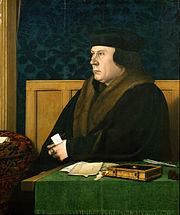
Thomas Cromwell as portrayed by Hans Holbein
It’s that duality of character that Mantel brings to center stage in Bring up the Bodies, conveying it in a third person narrative style that simultaneously has the intimacy of a first person narrator. Often those moments of character revelation come through short comments made almost en passant.
One such passage occurs when Cromwell is despatched by Henry to see the woman he divorced (Katherine of Arragon) in order to marry Anne Boleyn. Katherine is a problem that will not go away for this royal couple – she refuses to acknowledge the validity of the divorce, refuses to give allegiance to the new queen and is a focal point for Catholic plots against Henry. they need to know whether reports she is dying are true. What Cromwell sees is a shrunken figure of a woman  swaddled in an ermine fur cape.
She is jaundiced, and there is an invalid fug in the room – the faint animal scent of the furs, a vegetal stench of undrained cooking water, and the sour reek from a bowl  with which a girl hurries away: containing, he suspects the evauated contents of the dowager’s stomach.
Noticing the ermine fur coat in which she is swathed, the pragmatic side of Cromwell’s character comes to the forefront. “The king will want that back, he thinks, if she dies.’ But almost immediately the lens is changed to show his more thoughtful nature as he wonders whether Katherine’s dreams are of the gardens of the Alhambra she left as a young girl:
….the marble pavements, the bubbling of crystal water into basins, the drag of a white peacock’s tail and the scent of lemons. I could have brought her a lemon in my saddlebag, he thinks.
Four months after I closed the book, I could still remember that passage and the way Mantel shows Cromwell’s mind leap from the wizened creature he sees in front of him to a simple action he could have taken to remind her of a better life.
Moments like this abound within the novel. For that reason alone, Mantel for me deserved to win the Man Booker Prize 2012.


First posted at my blog site: http://allthingsbooker.wordpress.com/2012/12/09/review-bring-up-the-bodies/


Sunday, October 21, 2012

Karen's review - 2008 winner The White Tiger


There are some books that begin with a definite punch even if they are not always of the Hitchcock idea of a brick-through-the-window start to films. In White Tiger the punch isn't delivered by an event but through a narrator's voice that is so direct and immediate, that it demands attention.
We don't know who this narrator is yet other than he calls himself 'the White Tiger'  and classes himself as one of India's successful entreprenneurs. But he clearly  thinks he's important enough to write  letters to the Premier of China advising him what to expect when he pays a State visit to Bangalore. His letters are filled with scornful comments about the reality of life in India - a side to the country he believes the Premier will never see. For this narrator not only considers himself a great man just as much as the premier is, but the only person the Premier can trust to tell the truth. India's most sacred river, the Ganges, is one of the myths he smashes.

One fact about India is that you can take almost anything you hear about the country from the prime minister and turn it upside down and then you will have the truth about that thing. Now you have heard the Ganga called the river of emancipation ......our prime minister will no doubt describe it to you that way and urge you to take a dip in it. 
No! - Mr Jiaboa, I urge you not to dip in the Ganga, unless you want your mouth full of faeces, straw, soggy parts of human bodies, buffalo carrion and seven different kinds of industrial acids.
Gradually, we learn that this vocal critique of his mother country is Balram Halwai, son of a rickshaw wallah born in The Darkness, the poorest and most deprived part of India. Halwai gets an escape route into the other India, the India of Lightness, when he manages to get a job as a driver for Mr Ashok, the son of a wealthy landlord.
Through this outspoken, murderous protagonist, Aravind Adiga shows us the underbelly of India and the reality of its powerhouse economy of the early 21st century. Pouting models from the west may adorn the facades of new gleaming glass shopping malls but around the corner, are the slums where people live under meagre tarpaulin roofs. Through Balram's eyes we learn of the servant class of Delhi who live in rotting basements below the glass apartment blocks that are home to their employers. He tells how Ashok's family bribe government ministers, and how national elections are rigged.
Balram realises that people like him are trapped by the situation of their birth and the chains of family, unable to break out of the 'Rooster Coop' even when they know they will die if they don't:
On the wooden desk above this coop sits a grinning young butcher, showing off the flesh and organs of a recently chopped-up chicken, still oleaginous with a coating of dark blood.  The roosters in the coop smell the blood from above.  They see the organs of their brothers lying around them.  They know they're next.  Yet they do not rebel.  They do not try to get out of the coop."
Balram realises he has to take destiny in his own hands.  His employer is liberal and freely expresses his guilt at his driver's treatment but when his fine words never come to anything, Balram decides to kill him, steal his money and then go on the run.
The murder isn't a surprise however because within 12 pages of the book, Balram has told us he is a wanted man so the momentum for the plot doesn't turn on that surprise or even whether he will be tracked down by police and punished. The momentum really comes from the force with which Adiga's protagonist tells his story and pricks the bubble of India's status as a world power.  Hardly surprising that this debut novel, which won the Man Booker Prize in 2008,  was not well received in India. The Hindu, one of the country's leading English language newspapers, said it was a ' curiously inauthentic' portrait of the country written by an outsider for outsiders -  an “India for Dummies.”
Maybe no-one likes the country of their birth and the country they are proud of, to be held up for scrutiny in this way so those reactions are understandable. More of an issue for me was that the book seemed to lose its way in the final stages, about the time when Balram commits the murder - we already know it's coming so it had the sense of inevitability. Having told us how the killing is executed Adiga seemed to be in a great hurry to get to the last page as if he'd had enough of this character. So it felt a rushed and somewhat predictable ending which was such a shame for a book I'd thoroughly enjoyed up until then.

Sunday, October 7, 2012

Karen's Review - Skios - 2012 Longlist

Cross posted at:. http://allthingsbooker.wordpress.com

About a quarter of the way through Skios I began to wonder whether the Booker prize judges  had enjoyed a few too many glasses of ouzo when they decided to include Michael Frayn's latest novel in the 2012 longlist. How else to account for their choice of a comic novel about a set of characters caught up in a world that spirals into chaos.

It's actually in the genre of a theatrical farce but instead of the revolving doors and beds that you get with the likes of a Feydeau farce, in Skios we have red leather suitcases that get muddled up and then keep reappearing but in the wrong places, girlfriends who get mistaken for cleaning ladies, and phone calls/text messages that keep going astray.

Skios is set on a Greek island where the great and the wealthy are gathered for the annual retreat of the Toppler Foundation, agog to hear this years guest lecturer Dr Norman Wilfred give his key note address on "Innovation and Governance: the Promise of Scientometrics". It's a lecture he has touted around the world and delivered many times. But arriving at Skios airport, he gets distracted at the baggage carousel, discovers his suitcase has been taken by someone else and instead of being taken by taxi to be feted in the Toppler foundation guest lodge, he finds himself in a villa surrounded by little more than goats. Meanwhile, his luggage and his identity is taken by Oliver Fox, another passenger on the same plane. Although significantly younger than Dr Wilfred, Oliver manages to charm all the Toppler guests into believing he really is the esteemed expert on Scientometrics. Meanwhile, up at the villa surrounded by goats, waits the girl he is supposed to be meeting for a romantic weekend.

It's the kind of story line that worked well for Frayn in the 1980s with Noises Off, his stage play about a theatrical group rehearsing and then performing a sex-comedy. He used the same approach in his screenplay for the  film Clockwork starring John Cleese as a hapless headmaster beset by a litany of accidents on his way to a headmasters' conference.

Farce is harder to execute successfully on the page, than on the stage or in film. In Skios, Frayn shows why he is a master of this genre (which presumably is why he ended on the long list). The action is frenetic with a narrative focus that constantly switches from one set of characters and locations to another until it reaches an explosive ending.

Masterful?  Yes in terms of handling a complicated plot line. Enjoyable? Marginally so - you could read this on a sun lounger with eyes half closed and enjoy the odd chuckle or too. But that's about it. The problem for me was that the characters seldom rose above the level of painting-by-numbers figures - the plot device too often turned on that well-worn device of miscommunication between foreigners who can't speak each others language. It's difficult to care about what happens to any of these people.

 Skios does have its moments of acutely observed behaviour and attitudes. The world of the academic lecture circuit is an easy target for comedy and ridicule  (think David Lodge's Small World).  Frayn's satire is evenly balanced between the academics and their audiences: Norman lectures to "the Something Centre. Or the Something Institute. The Something Something. The Something Something for the Something of Something." to audiences who "had already had lectures on "the Crisis in this and the Challenge of that. They had an Enigma of, a Whither? and a Why?, three Prospects for and two Reconsiderations of."

Such moments get lost however amidst the frantic rushing about that farce requires.  Equally, there seems to be a theme about identity in which Frayn asks us to consider how we really know who we are - if our name and everything we supposedly represent can so easily be taken by another person, then what is left? But again, the comedy takes over and this question is never really explored.

Overall, this is a book that is well short of Frayn at his best. The kind of novel that is instantly forgettable once finished.


Saturday, August 25, 2012

2012 Long List - Unlikely Pilgrimage of Harold Fry


Harold Fry is one of those men whose life has never amounted to much. He's no more likely to suddenly start to walk from one end of England to the other, than he is to tell his boss at the brewery what he really thinks of his obnoxious behaviour to female staff.
And yet that's exactly what he does. Opening a letter at breakfast one morning six months into his retirement, he learns that a former colleague is at dying from cancer at a hospice in Berwick on Tweed.  He writes the blandest of responses and heads to the post box to catch the collection, except when he gets there he finds he can't post it because the words he has written are insufficient for what he really feels. He walks to the next box and the next and before he realises, he has been out for hours and is hungry. At a petrol station, an encounter with the assistant gives him the idea that he can do more for his friend than write - he can walk to see her. And by walking, he will keep her alive.
Dressed in deck shoes, shirt, tie, and waterproof jacket but without compass or map and only a vague idea of where Berwick is, he begins to walk the 600 miles or so from his home in Devon.
Humour shines through the opening chapters of this book through the incongruity of who Harold is and his touching belief in what he can accomplish. While the humour never disappears, it's shot through with poignant moments as Harold recollects episodes from his life.  He remembers everything that 'might have been' and how its all gone wrong. His wife Maureen, has changed from a long dark haired girl with whom he shared jokes, into a sharp-tongued harridan - now.  After 47 years of marriage, they live as strangers in a home where the air  is thick with recriminations.  Harold and his son David are also strangers - Maureen is the only one who talks to him.

Harold's inward journey is painful but yet it leaves him transformed.
 “The abundance of new life was enough to make him giddy....... England opened beneath his feet, and the feeling of freedom, of pushing into the unknown, was so exhilarating he had to smile. He was in the world by himself and nothing could get in the way or ask him to mow the lawn.”
The plot is quite a simple one and is narrated simply. There are no long descriptive passages or extensive meditations on the meaning of life. But it's never twee because Rachel Joyce cleverly counter balances the poignant moments and the humourous ones to deliver a delightfully quirky book. It's a story very much about the renewal of hope and reflection of how easily we lose our way and how much courage it can take to find it again.
This is Rachel Joyce's first novel although she has enjoyed a successful career first as an actress and then as a playwright for radio. Getting long listed for the Booker Prize is quite an achievement for a first novel although I don't think she'll get the prize. Nevertheless I would rate it as one of the most enjoyable books I've read this year .

Review was originally posted at my blogsite Booker Talk 

Tuesday, July 17, 2012

Review - Offshore - 1979


Penelope Fitzgerald has been compared to D H Lawrence or Evelyn Waugh for her ability to depict the subtle interactions between her characters. Two of her novels - The Beginning of Spring and The Gate of Angels - were shortlisted for the Man Booker Prize. With that pedigree in mind, and the eulogy from Sebastian Faulks on the back of my copy of Offshore - the novel with which  she did win the Booker in 1979, I was in hope of a good experience.   
According to Faulks 'reading a Penelope Fitzgerald novel is like being taken for a ride in a peculiar kind of car. Everything is of top quality - the engine, the coachwork and the interior all fill you with confidence. Then, after a mile or so, someone grows the steering wheel out of the window. 
Now I’ve finished Offshore, I’m left wondering whether Faulks was actually talking about a totally different book. I kept waiting for the moment when the unexpected would actually happen. By the end, even a chip packet being thrown out of the car window might have felt like progress. But even that was denied. 
Offshore never really got going for me. It felt as if Fitzgerald conceived the idea of a novel featuring a mixture of offbeat characters all of whom are at a turning point in their lives. Then to give it more appeal, she makes them live in houseboats in a less than desirable stretch of the River Thames. We trace their lives as they unravel or , in the case of one of the river dwellers, sink.  But it’s difficult to engage with these characters or feel very interested in what happens to them because they are only sketchily depicted. Their eccentricities are not markedly eccentric, or even odd. The most interesting character for me was Maurice a male prostitute whose friendly nature is repeatedly taken advantage of who use his boat as a place to stash their stolen goods. But he is absent from the book for much of the time. Nenna, the central character, is a bohemian Canadian whose husband has left her and who is left quite literally struggling to keep things afloat. The scenes in which wanders shoeless through the streets of London late one night, are the most memorable. But it’s not enough to rescue the novel.
According to a quote from the Observer on the back of my copy, Offshore is ‘a novel of crisp originality, lucid and expressive with some splendid bursts of satire’. Would that it were so. For me, the narrative sank deeper and deeper into the mud of the Thames, occasionally bobbing up for air to fool readers into thinking that something would now actually happen, only to subside even further into the depths. The experience left me feeling  I’d been cheated.

A version of this review was first posted on Booker Talk

Wednesday, July 4, 2012

Review - Staying On - 1977

This review also appears on my blog at http://allthingsbooker.wordpress.com


Staying On is a quiet coda to the more epic approach Paul Scott took in his Raj Quartet series in which he depicts the final stages of the collapse of imperialism in India and the birth of a new independent nation.  It’s a process that Scott once described as ‘the British coming to the end of themselves as they were’. For many of the key figures in the quartet, the new order did indeed force them to question their own attitudes and beliefs. Only a few chose to remain once they were no longer in charge of the country.


With Staying On, Scott moves us forward 20 years after India’s independence.  The  action is located in the same small hill town of Pankot that featured in the earlier novels and makes reference to some of the same buildings and areas. He introduces several new characters (both Indian and British ) but he makes a few others reappear —  most notably two of the minor characters from the Quartet -  Tusker and Lucy Smalley. The last British couple remaining in Pankot, their world has shrunk as their fortunes have declined.  Tusker’s retirement from the British Indian Army  and his subsequent career in administration for a maharaja have left them with limited funds which have been further eroded it transpires, by a stint of gambling. 


By the time we meet them they are living in straightened circumstances in the Lodge, a small annex of Smith’s Hotel which was once the town’s principal hotel but is now overshadowed by the brash new Shiraz Hotel.  The Smalleys, like Smith’s Hotel, are adrift in the new India. They try desperately to cling to the old order with its esteemed values of the family and tradition and its strict codes of behavour.  But such currency no longer matters in the new India, in which its the entrepreneurs and money makers who hold sway.
The Smalleys are an ill matched pair.  He is brusque, irascible and prone to spontaneous irrational actions;  she is loquacious, a romanticist who believes many of the young English officers she has met over the years, were secretly attracted to her. Lucy Smalley has never forgiven her husband for deciding —  without consulting her  —  that they would ‘stay on’ in India after he retired from the army. As her husband’s health declines, she becomes increasingly worried about her financial status when he dies. But her pleas for information are unanswered and in place of real conversations with her taciturn husband she creates imaginary dialogues in which she shows a male visitor the delights of Pankot and introduces him to local society.
What Scott brings to life is that despite the feelings of frustrations, anger and disappointment that encircle the Tusker’s marriage, there is still an affection that has endured. Staying On is in essence a tale of loss; of unfulfilled dreams and years lived always on the fringe, never quite ‘fitting in’. When I first read this novel about 15 years ago, the comic storyline of the larger-than-life Mrs Bhoolabhoy and her henpecked husband seemed to dominate the novel. I felt the domestic nature of the plot made the novel feel rather lightweight in comparison to the Raj Quartet. But reading Staying On again, the poignancy of Lucy’s story came more to the forefront. How could I not feel sorry for a woman who has
‘a faraway look in her eyes as if looking back into places she’s walked in her long-ago shoes.'
It’s true that Staying On doesn’t tackle the same big issues as the Raj Quartet or focus similarly highly dramatic events.  Gone are the questions around loyalty to one’s birth nation and community versus loyalty to an acquired social group like the regiment.  Gone also is the question Scott poses in The Jewel in the Crown (the first of the quartet) about the personal and socio-political consequences that arise when individuals try to cross the racial divide.  There are certainly no dramatic events inStaying On like the rape in Jewel in the Crown, or the massacre on the train inDivision of the Spoils. In fact the main drama of Staying On is dispensed with in the very first page where we learn that Tusker has died while Lucy is at their hairdressers. And yet there is one theme that seems to tie all five novels together – the ability of human beings to connect with each other; whether across class or across the breakfast table. Lucy and Tusker have as much of a divide between them as Ronald Meyrick and Sarah Leighton or Daphne Manners and Hari Kumar experience in The Jewel.
The recognition that Scott earned with Staying On — most notably the Booker Prize in 1977  — is in stark contrast to the muted enthusiasm which greeted publication of the Raj Quartet and the accusations that he had written caricatures of the British in India  and those who served them.  Sadly he  did not have long to enjoy the Booker success . In the year he won the award, he was diagnosed with cancer. He was too ill to attend the prize giving ceremony and died five months later.
If you want to learn more about Paul Scott, take a look at this Short Bibliography