Lots of reviews of this book say it is too depressing, too miserable. This is a book about a suicide, its hardly likely to be full of happiness and joy.
The book is narrated by a middle aged, middle class woman, with a seemingly perfect life - she's at home looking after the kids, whilst her husbands business is going so well she can buy anything she wants. But she isn't happy.
When her brother commits suicide she starts mulling over events in the past, her past and her families past, as well as the present, her lifeless, loveless marriage. Veronica is from a large family, one where the kids all drag up each other. The mother has too many kids to care about each child individually, and she also has some type of problem, so the family is constantly trying to protect her from the live going on around her. Veronica seems to hate, and yet love her mother, and also blames her father for having to grow up in this overly large family.
After her brother's suicide, Veronica explores a past she would have never known, the meeting of her grandparents, and how that meeting led to the event that she says it the root cause of her brother's death.
This novel is firmly based in the thoughts of the narrator, no great event happens, and you guess early on what childhood event will be revealed. I felt I never knew whether to trust this narrator, at some points she even told you that she couldn't clearly remember events. I also didn't really like her, or any of her family, they all seemed fairly self absorbed, no one really seemed to love anyone else, they all just existed side-by-side.
Saying that I thought it was well written, and a good read.This was the last book I had to read for the 2008 Man Booker Challenge, this year I read:
1. The Gathering (winner)
2. The Famished Road (winner)
3. Sour Sweet (Short listed 1982)
4. Moon Tiger (winner 1986)
5. Mister Pip (Short listed 2007)
6. The Orchard on Fire (Short listed 1996)
By far my favorite was Mr Pip. In the next year I shall be reading all the of the 2008 shortlist, as well as some previous winners and runners up
Thursday, October 30, 2008


Wednesday, October 29, 2008
The Blind Assassin - Atwood, Jackie's Review

This is the first book by Margaret Atwood that I have read. Reviews of her books always seem to be very positive, so I was expecting a good book. Unfortunately I was very disappointed. The plot was predictable and uninspiring. The characters had no special qualities, and came across as boring people. The writing was OK, but not particularly atmospheric. I was expecting much more, from a prize winning book by a critically acclaimed author.
Many reviews state that this is a hard book to get into, and confusing, as it skips around so much. I didn’t find this to be a problem, as there was a good read before the book skipped time frames. I also found it quite easy to get into. The book flowed along well throughout it’s 600+ pages, but at the end I felt let down. I’ll have forgotten about this book in a few days, as there was nothing special about it.
Very average.
5 out of 10 stars
Many reviews state that this is a hard book to get into, and confusing, as it skips around so much. I didn’t find this to be a problem, as there was a good read before the book skipped time frames. I also found it quite easy to get into. The book flowed along well throughout it’s 600+ pages, but at the end I felt let down. I’ll have forgotten about this book in a few days, as there was nothing special about it.
Very average.
5 out of 10 stars
Thursday, October 23, 2008
The White Tiger - 3M's Review
 The White Tiger
by Aravind Adiga
2008 Booker Prize winner
2008, 276 pp.


Hmmm, well, I happened to get this book from the library on the Saturday before the Booker Prize was announced "just in case." When The White Tiger was revealed as the winner, I was really surprised. Not only did it have the longest odds to win, but I had recently read The Secret Scripture and not-so-secretly hoped it would win. In fact, the committee admitted these two were the main contenders and that the decision was not unanimous.
To be honest, I kind of groaned when I heard Adiga's book was the winner. I don't have a love affair at all with the Booker prize winners that I've read, so I was a little skeptical that I would enjoy this one. But, being the trooper that I am, I thought I'd give it at least 40 or so pages to see if it could capture my interest.
Surprise, surprise; it did. Not only is it a scathing indictment against India's treatment of its poorest citizens, it also manages to be a clever black comedy. This is exactly what the prize committee chairman revealed as the reason behind its decision. So which book did I like better, The White Tiger or The Secret Scripture? It's really comparing apples to oranges. They're just not the same type of book at all. They both are worthy social commentaries on the authors' home countries, but just written in a totally different style. While Sebastian Barry's prose is lyrical, Adiga's is biting (and comical). They both work spectacularly, just in different ways. I can definitely see why the committee had a difficult decision on its hands, and either one would have been a winner in my book.
Black Dogs by Ian McEwan - Tammy's review
 Title: Black Dogs
Author: Ian McEwan
No. of Pages: 176
Synopsis (from B&N): "Set in late 1980s Europe at the time of the fall of the Berlin Wall, Black Dogs is the intimate story of the crumbling of a marriage, as witnessed by an outsider. Jeremy is the son-in-law of Bernard and June Tremaine, whose union and estrangement began almost simultaneously. Seeking to comprehend how their deep love could be defeated by ideological differences Bernard and June cannot reconcile, Jeremy undertakes writing June's memoirs, only to be led back again and again to one terrifying encouner forty years earlier--a moment that, for June, was as devastating and irreversible in its consequences as the changes sweeping Europe in Jeremy's own time. In a finely crafted, compelling examination of evil and grace, Ian McEwan weaves the sinister reality of civiliation's darkest moods--its black dogs--with the tensions that both create love and destroy it."
Fiction or Nonfiction: Fiction
Comments and Critique: This is the first Ian McEwan novel that I've read. I'm amazed at how skillful he is with words, it makes me so jealous. This is one of those books in which the plot really isn't important. What is important is the interaction of the characters and the psychology behind those interactions. I actually read this book several months ago and unfortunately did not make any notes, so I feel unequipped to provide an adequate review here. All I can say is that I thought it was a great book and I'm absolutely going to keep McEwan's other books on my TBR list.
For a professional opinion of this book, see Bette Pesetsky's review in the New York Times (originally published Nov. 8, 1992) here.
Would You Recommend This Book to Others: Yes
Wednesday, October 22, 2008
Tammy - intro and progress
I'm yet another participant in Dewey's Man Booker challenge. You can check out my blog at Tammy's Book Nook. You can read my reviews by clicking on the book titles. The books I've read so far from the Booker list:
1996 - Alias Grace by Margaret Atwood (shortlist)
1992 - Black Dogs by Ian McEwan (shortlist)
2000 - The Blind Assassin by Margaret Atwood
2003 - The Curious Incident of the Dog in the Night-time by Mark Haddon (longlist)
2002 - Fingersmith by Sarah Waters (shortlist)
1997 - The God of Small Things by Arundhati Roy
1986 - The Handmaid's Tale by Margaret Atwood (shortlist)
2002 - Life of Pi by Yann Martel
1981 - Midnight's Children by Salman Rushdie
2005 - Never Let Me Go by Kazuo Ishiguro (shortlist)
1990 - Possession: A Romance by A.S. Byatt
1989 - The Remains of the Day by Kazuo Ishiguro
1993 - The Stone Diaries by Carol Shields (shortlist)
1996 - Alias Grace by Margaret Atwood (shortlist)
1992 - Black Dogs by Ian McEwan (shortlist)
2000 - The Blind Assassin by Margaret Atwood
2003 - The Curious Incident of the Dog in the Night-time by Mark Haddon (longlist)
2002 - Fingersmith by Sarah Waters (shortlist)
1997 - The God of Small Things by Arundhati Roy
1986 - The Handmaid's Tale by Margaret Atwood (shortlist)
2002 - Life of Pi by Yann Martel
1981 - Midnight's Children by Salman Rushdie
2005 - Never Let Me Go by Kazuo Ishiguro (shortlist)
1990 - Possession: A Romance by A.S. Byatt
1989 - The Remains of the Day by Kazuo Ishiguro
1993 - The Stone Diaries by Carol Shields (shortlist)
Monday, October 20, 2008
Possession
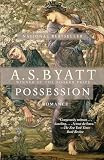 This 1990 Booker Prize winner was second only to LOTR on the poll of what books I should take. It seemed to be popular with the visitors and I can understand why. I read this during my unfortunate delay before departure. It was absorbing and while a bit lengthy at over 500 paperback pages, enjoyable. It is complex, literary, stylistically varied, and meta. There are various writing styles employed from poetry, critical academia, memoir writing, fairytales, to epistolary writing. While I found the ending just a tad too maudlin and the modern characters Maud and Roland not as well drawn out as Ash and Christabel, I liked the book overall. Byatt obviously took care in tracing the mystery aspect, and it is certainly not a conventional romance (or romances). It has many themes and interesting implements. It has academics writing not about poets, but also other academics. There's a definite sense of meta literary and commentary beneath the surface. The idea of not only romantic possession, but that which possesses us from the long gone writers. It reminds me of Shakespeare academia and the sheer obsession academics have about him whoever he may be. Just a little thing could just how history views people and how we are enthralled, or "possessed" with the dead and ideas from and of them. I am glad to own this novel as I find that it will be immensely rereadable.
Crossposted from aquatique.net
Sunday, October 19, 2008
3M's Progress
Read in 2008:
2008 The White Tiger ****1/2 by Aravind Adiga
2007 The Gathering**** by Anne Enright
2002 Life of Pi**** by Yann Martel
1984 Hotel du Lac by Anita Brookner
1983 Life & Times of Michael K**** by J. M. Coetzee
Read in 2007:
2006 - The Inheritance of Loss*** by Kiran Desai
2005 - The Sea** by John Banville
2000 - The Blind Assassin ***1/2 by Margaret Atwood
1997 - The God of Small Things ***1/2 by Arundhati Roy
1985 - The Bone People***1/2 by Keri Hulme
2008 The White Tiger ****1/2 by Aravind Adiga
2007 The Gathering**** by Anne Enright
2002 Life of Pi**** by Yann Martel
1984 Hotel du Lac by Anita Brookner
1983 Life & Times of Michael K**** by J. M. Coetzee
Read in 2007:
2006 - The Inheritance of Loss*** by Kiran Desai
2005 - The Sea** by John Banville
2000 - The Blind Assassin ***1/2 by Margaret Atwood
1997 - The God of Small Things ***1/2 by Arundhati Roy
1985 - The Bone People***1/2 by Keri Hulme
Saturday, October 18, 2008
Thursday, October 16, 2008
Laura's Review - Last Orders

Last Orders
Graham Swift
295 pages
In this Booker prize-winning novel, four men spend a day travelling from London to the coast to scatter the ashes of Jack Dodds, as he requested just before his death. Three of the men -- Ray, Lenny, and Vic -- have been friends with Jack for most of their adult life, living in the same working-class community, and earning their living in local businesses. The fourth, Vince, is Jack's son. Thoughts, feelings, and history are revealed through short chapters, each told from one character's point of view. Each man has experienced love, loss, friendship, disappointment, and varying degrees of prosperity. Their lives are intertwined, sometimes in ways that the characters are unaware of individually. For the most part, these men swagger and boast while inside, they are full of pain. There are a few women in this book, but they are minor characters. Jack's wife, Amy, is portrayed in the most detail. I felt sorry for her; she was trapped in a less-than-satisfying marriage, with family obligations that Jack refused to share.
Swift has a way of evoking a time and place, and the characters seemed like real people. Their stories were moving in parts. I'm a bit surprised this won the Booker Prize, as it doesn't seem to compare to other winners I've read, but it's a passable if somewhat melancholy read. (
 )
)My original review can be found here.
Wednesday, October 15, 2008
Aravind Adiga wins 2008 Booker Prize

Aravind Adiga has won the 2008 Booker Prize for his novel, The White Tiger. He is only the 4th first-time novelist to win the prize, the last one being Keri Hulme for The Bone People. For more information, read this article from The Guardian. For some odd reason, the Man Booker Prize website does not have a press release up yet.
The winners list on the sidebar now includes the 2008 winner.
Monday, October 13, 2008
The Secret Scripture - 3M's Review
The Secret Scripture
by Sebastian Barry
2008, 300 pp.
Booker Prize Shortlist
Rating:
 I'd be happy if this book won the Booker Prize. Yeah, I would, and I haven't read any of the other contenders yet! Sebastian Barry is a magnificent writer, and I will definitely be reading more of his work.
Roseanne McNulty is almost 100 years old, and Dr. Grene is the psychiatrist attending her at Roscommon Mental Hospital. The story slowly unfolds by giving alternating accounts of Roseanne and Dr. Grene. As he seeks to understand her and her tragic past, he must also deal with some tragedy of his own. As everyone knows, 'grief lasts two years.'
With Ireland as a backdrop and themes of religion, mental illness, and family loyalty and betrayal, The Secret Scripture is superbly crafted and is definitely worthy of the Booker Prize.
by Sebastian Barry
2008, 300 pp.
Booker Prize Shortlist
Rating:
 I'd be happy if this book won the Booker Prize. Yeah, I would, and I haven't read any of the other contenders yet! Sebastian Barry is a magnificent writer, and I will definitely be reading more of his work.
Roseanne McNulty is almost 100 years old, and Dr. Grene is the psychiatrist attending her at Roscommon Mental Hospital. The story slowly unfolds by giving alternating accounts of Roseanne and Dr. Grene. As he seeks to understand her and her tragic past, he must also deal with some tragedy of his own. As everyone knows, 'grief lasts two years.'
With Ireland as a backdrop and themes of religion, mental illness, and family loyalty and betrayal, The Secret Scripture is superbly crafted and is definitely worthy of the Booker Prize.
What can I tell you further? I once lived among humankind, and found them in their generality to be cruel and cold, and yet could mention the names of three or four that were like angels.
Sunday, October 12, 2008
Life of Pi - 3M's Review
 Yann Martel’s Life of Pi won the Booker Prize in 2002. It’s the story of Pi Patel from his childhood to his time on a lifeboat after the ship carrying his family and his father’s zoo animals sinks. Richard Parker, a Bengal tiger, shares Pi’s fate on the raft. Due to the tiger, he must constantly be on guard during his 227 day ordeal.
 I really didn’t get all that much into the story until the ship sunk — it really gets going at that point. And then, just when I was getting tired of all the desperate tactics for survival in the lifeboat, another interesting development occurs. I was surprised by the twist ending as well, but it was a good one. I was impressed by the symbolism in the book. Recommended.
2001, 319 pp.
Rating: 
Wednesday, October 8, 2008
'A Fine Balance' by Rohinton Mistry - Jackie's Review

‘A Fine Balance’ was short listed for the Booker prize in 1996, and I cannot understand why it did not win this, or even ‘The Booker of Bookers’ - it is that good!
It is hard to explain the plot, as it is so rich and complex, but basically it follows the lives of four strangers, from different sections of the Indian caste systems as they deal with life during the state of emergency in 1970’s India. The political situation is explained, so that even an outsider can understand the corruption and turmoil going on in the country. Each character is built up so well, that we feel we know them, and the surroundings are described in such a way that I imagine I’ve been there. It is not an easy read, in that many of the scenes described are disturbing, but the hardship is not dwelt upon, and it is amazing what positives can be made out of so little.
At over 600 pages long, it is not a short book, and I was originally going to criticise it for not being a page turner. I now realise that this would be the wrong thing to do. Although it is not a fast paced book, I was gripped the whole way through. If it had been a quicker read it would have lost the rich detail I loved it for.
This book changed the way I viewed many aspects of Indian society, particularly the street beggars, and I now have a greater understanding of life in India during the 1970s.
This is one of the best books I have ever read. I cannot recommend it highly enough.
10 out of 10 stars.
It is hard to explain the plot, as it is so rich and complex, but basically it follows the lives of four strangers, from different sections of the Indian caste systems as they deal with life during the state of emergency in 1970’s India. The political situation is explained, so that even an outsider can understand the corruption and turmoil going on in the country. Each character is built up so well, that we feel we know them, and the surroundings are described in such a way that I imagine I’ve been there. It is not an easy read, in that many of the scenes described are disturbing, but the hardship is not dwelt upon, and it is amazing what positives can be made out of so little.
At over 600 pages long, it is not a short book, and I was originally going to criticise it for not being a page turner. I now realise that this would be the wrong thing to do. Although it is not a fast paced book, I was gripped the whole way through. If it had been a quicker read it would have lost the rich detail I loved it for.
This book changed the way I viewed many aspects of Indian society, particularly the street beggars, and I now have a greater understanding of life in India during the 1970s.
This is one of the best books I have ever read. I cannot recommend it highly enough.
10 out of 10 stars.
Monday, October 6, 2008
Possession: A Romance
Maud shivered, as she always shivered, on reading this document. What had Christabel thought, when she read it? Where had Christabel been, and why had she gone, and where had Randolph Ash been, between July 1859 and the summer of 1860? There was no record, Roland said, of Ash not being at home. He had published nothing during 1860 and had written few letters - those there were, were dated from Bloomsbury, as usual. LaMotte scholars had never found any satisfactory explanation for Christabel's apparent absence at the time of Blanche's death, and had worked on the supposition of a quarrel between the two women. This quarrel now looked quite different, Maude thought, without becoming clearer.I finally finished reading Possession: A Romance, by A.S. Byatt. I'm sorry to say that I never felt truly drawn into the story. It reminded me of something my mom once said when I was working on my Masters Degree in Comparative Literature. She said, "I'm not a huge fan of 'capital L Literature'. What I want to read is a good story." Not that the two are mutually exclusive, and I would argue that the best of 'capital L Literature' is great because of the story, not because of the genius of the author. Reading Possession, I never got sucked in, I was always waiting for the story to have some passion, some caring for the characters, some real drama. I found it had tenderness toward its characters, and there is real skill in the way that Byatt interweaves diaries, letters, and narrative to tell her story. But again, I couldn't make myself care about any of it.
The book starts with a young, frustrated academic, Roland Michell, doing some research on his subject, (fictional) Victorian poet Randolph Ash. He comes across some unfinished letters in Ash's handwriting, tucked amongst the pages of a book in the library. Impulsively, he tucks the letters into his wallet, rather than alerting the librarian of their existence, or at least tucking them back where they belong. The letters appear to be to a woman that Ash has just met, and feels a connection to. He wants to see more of her. But who is she? Scholarship on Ash is that he was a faithful husband, happily married to the same woman for over 40 years. Roland asks around, and ends up entering into a partnership with Maud Bailey, a scholar who studies the life and works of a contemporary of Ash, Christabel LaMotte, the woman for whom Ash's letter was meant.
Roland and Maud go on a search for the truth, which they are hiding from their contemporaries in LaMotte and Ash studies, hoping to be the ones to break the story to the academic world, which would be a huge feather in their caps, and a great help in their careers as well. The rest of the book travels between their story and that of LaMotte and Ash, which is told mainly through their letters to one another, through their respective poems, and through diaries written by Ash's wife and LaMotte's cousin. It's intriguing enough, with plenty of twists and turns and surprises to keep the reader interested. Unfortunately, for me, Byatt kept her characters at an emotional distance, so while I was slightly interested in finding out what had happened between these Victorian poets 150 years ago, I sort of resented the amount of time and effort that I had to put into the discovery.
'Flying to Nowhere' by John Fuller - Jackie's review

‘Flying to Nowhere’ is set on a Welsh island, and is centred around a monastery. A church agent comes to the island to investigate the disappearance of pilgrims visiting a sacred well, while the local abbot is at his dissection table searching for the location of the soul.
I have no idea why this book was short listed for the Booker prize in 1983 – it is so dull!
At only 88 pages long it was a very quick read, but it seemed to take ages, as there was nothing in the book that captivated me. The plot was very basic, the characters failed to engage me, and there was too much rumination on life, death, the spirit and the soul.
1 ½ stars out of 5
I have no idea why this book was short listed for the Booker prize in 1983 – it is so dull!
At only 88 pages long it was a very quick read, but it seemed to take ages, as there was nothing in the book that captivated me. The plot was very basic, the characters failed to engage me, and there was too much rumination on life, death, the spirit and the soul.
1 ½ stars out of 5
Subscribe to:
Posts (Atom)
Ian McEwan
125 pages
Colin and Mary are on an extended holiday in Venice. They spend long, lazy days idling in their hotel or wandering the streets, often getting lost. Late one evening, out in search of a restaurant, they meet a man named Robert who takes them to a nearby bar and, later, to his home. Robert is overly friendly and forward, but Colin and Mary are drawn to him in spite of their better judgement. Their time with Robert is inexplicably arousing, so much so that they spend the next few days sequestered in their hotel room. When they emerge they find themselves unconsciously drawn to Robert again. And things get really creepy and evil ... as if they weren't already.
Ian McEwan has written an expertly crafted thriller; I was riveted from the first few pages. As McEwan drove relentlessly toward the story's almost inevitable conclusion, I was actually relieved that the book was only 125 pages -- the suspense and intensity would have been difficult for me had it been longer. I had picked this book up quite by accident, in need of a short read while waiting for library books. I was very pleasantly surprised by its quality & punch. (