- Restoration by Rose Tremain (short list)
- Paddy Clarke Ha Ha Ha by Roddy Doyle (winner)
Friday, September 26, 2008
Terri - Quarterly Check-in September '08
Just a quick check-in and progress report since my last report the end of June. I haven't read anything on that list - yet! - but I did read two other Bookers:


Wednesday, September 24, 2008
Katrina's review of The Famished Road (1991 Winner)

This book about the life a a spirit-child, he struggles and fights for his chance to live, and at many times has to fight against the spirits who want him to return to the spirit world.
The book deals with many African political and social problems, including poverty, hunger, lack of stability and the dirty tricks and means used by politicians to capture as man votes as they can. The whole community is filled with spirits and their actions can affect the life of all, yet the boy is the person most affected. He moves between normal life, the spirit world and a time and space where they both converge.
I'll be honest and say that this book was a struggle, I'm sure that their were many references to folk tales, religion and cultural beliefs that I just didn't know enough about to recognise. However, this is a book that I wish I had had the opportunity to study when I was at university, it would have been great to learn about the influences, origins and context of the novel and to attend seminars and hear other peoples views about it.
Challenges:
2008 Booker Challenge: Book 5/6
Fall into Reading: Book 1
Olympic Challenge: Nigeria
Book Awards 2: Book 1/10
Friday, September 12, 2008
'G' by John Berger - Jackie's Review

‘G’ is about the life of a privileged family, living in Italy, at the turn of the century.
The majority of the book was the fairly boring story of ‘G’. I felt very little empathy for his character, and got more disinterested in his life as the book went on.
Very early into the book a few graphic sex scenes are thrown in. I say thrown, as there seems to be no real reason for their presence. They do not add anything to the story line, and seem only to be there to shock the reader. I was not shocked, but this along with the childish drawing of penises make parts of this book feel as though they are written by a teenage boy.
There are a few more sex scenes later on in the book, which at least seem to be part of the story, but again brought the book down to a much lower level. It then deteriorated into inane ramblings by the author, about the quality of sexual experiences.
There were a few interesting historical pieces in the book, but it wasn’t worth having to read the rest of the book, just for these few, short paragraphs.
Overall, the book felt very disjointed. The characters were shallow, and I would only recommend this book to teenage boys in need of a bit of sexual education!
1 ½ stars out of 5.
The majority of the book was the fairly boring story of ‘G’. I felt very little empathy for his character, and got more disinterested in his life as the book went on.
Very early into the book a few graphic sex scenes are thrown in. I say thrown, as there seems to be no real reason for their presence. They do not add anything to the story line, and seem only to be there to shock the reader. I was not shocked, but this along with the childish drawing of penises make parts of this book feel as though they are written by a teenage boy.
There are a few more sex scenes later on in the book, which at least seem to be part of the story, but again brought the book down to a much lower level. It then deteriorated into inane ramblings by the author, about the quality of sexual experiences.
There were a few interesting historical pieces in the book, but it wasn’t worth having to read the rest of the book, just for these few, short paragraphs.
Overall, the book felt very disjointed. The characters were shallow, and I would only recommend this book to teenage boys in need of a bit of sexual education!
1 ½ stars out of 5.
Tuesday, September 9, 2008
Last Orders
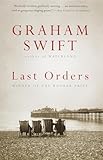 This Booker Prize winning book by Graham Swift tells of four men on a day trip to scatter their friend's ashes to the sea. The chapters are short and the narratives switches with each chapter. Most are told by Ray, the closest friend of the dead man Jack Dodds. There are numerous flashbacks revealing the lives of all the men and a couple of others in their lives. The dialogue is quite sharp and well written; Swift has a knack for characterisation. The language and changing perspectives makes it evocative. I sometimes managed to feel the bitterness and the anger that some of the characters do when they narrate. It is very English; all the characters have a working class background and there is something very stylistic and true about the way he writes about their livelihood. If anything, it feels sincere even if real working class Londoners do not all the issues these characters did. I liked the book for the most part, but it got bit depressing the further you went. The flashbacks reveal missed opportunities, unsaid things, wrong choices, bad luck, and estranged relationships. The ending, as with life, is open ended. Not a very uplifting read, but Swift does have a good voice throughout the story.
For a review of the film as well, go to aquatique.net.
2008 Shortlist Announced!
The 2008 shortlist has been announced, and they are:
First time novelists supercede previous prizewinners
- The White Tiger, by Aravind Adiga
- The Secret Scripture, by Sebastian Barry
- Sea of Poppies, by Amitav Ghosh
- The Clothes on Their Backs, by Linda Grant
- The Northern Clemency, by Philip Hensher
- A Fraction of the Whole, by Steve Toltz
You can find more information about these books in these posts:
- Trevor's Review of the 2008 Longlist
- Redheadrambles' review of The White Tiger
First time novelists supercede previous prizewinners
Sunday, September 7, 2008


Saturday, September 6, 2008
Possession by A.S. Byatt (Jill)
 Possession
By A.S. Byatt
Completed September 5, 2008
Possession by A.S. Byatt was a literary detective story that is loved by many readers. Winner of the Man Booker Prize, the story of Roland Mitchell and Maud Bailey’s search of a possible love affair between two Victorian poets has delighted readers all around the world.
For me, I enjoyed the “detective side” of Possession. I was on the edge of my seat when Roland and Maud combined forces to determine if fictional poets, Randolph Henry Ash and Christabel LaMotte, were in love with each other. Roland first discovered drafts of letters in Ash’s archives, which led him to Maud, an expert in LaMotte’s poetry. They continued to search through letters, replicate Ash’s holidays and comb through archives to find the connection between these contemporary poets – all while trying to hide their possible discovery from more well-known and wealthier scholars.
I respected Byatt’s ability to replicate Victorian prose. We learned about Ash and LaMotte only through their poetry and letters. She had to create all of this – and it was a lot – which I thought was a remarkable task.
My main complaint about Possession,though, is the overabundance (in my opinion) of Victorian prose that you have to sift through. I am not a fan of Victorian prose, so this is a personal bias. I handled the letters, but when it came to pages of poetry, I found myself skipping ahead.
This book has piqued my interest in the movie, but other than that, it’s a book that I can now check off my list. I don’t regret reading Possession, but I am glad to move on to books that better suit my reading tastes. (
 )
)
Friday, September 5, 2008
Trevor's Review of the 2008 Longlist
I just finished reading all but one and a half of the thirteen books on the 2008 longlist (didn't finish The Northern Clemency and didn't start Girl in a Blue Dress.
It wasn't a good year in my opinion. Here is my ranking of the books. If you click on them, you can get my full review with comments from other readers.
1. Netherland, by Joseph O'Neill
2. The Clothes on Their Backs, by Linda Grant
3. A Fraction of the Whole, by Steve Toltz
4. Sea of Poppies, by Amitav Ghosh
5. From A to X, by John Berger
6. The Secret Scripture, by Sebastian Barry
7. The Lost Dog, by Michelle de Kretser
8. The White Tiger, by Aravind Adiga
9. A Case of Exploding Mangoes, by Mohammed Hanif
10. The Enchantress of Florence, by Salman Rushdie
11. The Northern Clemency, by Philip Hensher
12. Child 44, by Tom Rob Smith
While I liked aspects of almost all of the books, only the top three were enjoyable to read throughout. And I'm not sure they were particularly strong or not. Still, it's a great prize, and I look forward to seeing which one of the luck books takes it away this year!
It wasn't a good year in my opinion. Here is my ranking of the books. If you click on them, you can get my full review with comments from other readers.
1. Netherland, by Joseph O'Neill
2. The Clothes on Their Backs, by Linda Grant
3. A Fraction of the Whole, by Steve Toltz
4. Sea of Poppies, by Amitav Ghosh
5. From A to X, by John Berger
6. The Secret Scripture, by Sebastian Barry
7. The Lost Dog, by Michelle de Kretser
8. The White Tiger, by Aravind Adiga
9. A Case of Exploding Mangoes, by Mohammed Hanif
10. The Enchantress of Florence, by Salman Rushdie
11. The Northern Clemency, by Philip Hensher
12. Child 44, by Tom Rob Smith
While I liked aspects of almost all of the books, only the top three were enjoyable to read throughout. And I'm not sure they were particularly strong or not. Still, it's a great prize, and I look forward to seeing which one of the luck books takes it away this year!
Jackie's review of 'The Accidental' by Ali Smith

The book started off quite promisingly, with the meandering thoughts of a 12 year old girl. The writing style was very unusual, but I found it amusing, and although some of the thoughts were a bit too profound for a 12 year old, overall I found it quite convincing. The book continued quite well, with the guilty thoughts of her older brother, but then it went downhill with the introduction of Amber, a stranger introduced into the household. I found her character extremely annoying, and ultimately pointless.
The reader is then confronted with several chapters of poetry. This is just weird, unnecessary, and it feels as though the author is just trying to be too clever.
It doesn’t improve. The plot just disappears, the characters become more annoying, and the stream of conscious thought becomes monotonous and dull.
Avoid it if you can.
2 out of 5 stars
The reader is then confronted with several chapters of poetry. This is just weird, unnecessary, and it feels as though the author is just trying to be too clever.
It doesn’t improve. The plot just disappears, the characters become more annoying, and the stream of conscious thought becomes monotonous and dull.
Avoid it if you can.
2 out of 5 stars
Monday, September 1, 2008
Jackie's review of Master Georgie

Master Georgie was short listed for the Booker prize in 1998, and is the first book I have read by Beryl Bainbridge. It is about a group of 3 people who set out from Victorian Liverpool to the Crimean war.
I found the book relatively easy to read, but the plot moved very slowly. The characters did not engage me, and the whole book seemed to lack the depth required for a decent read. The last 20 pages of the book were the only ones with any substance. Unfortunately these are the ones where the characters finally get to the Crimean war, and so are very disturbing. I was torn between wanting the action to have happened earlier, therefore getting a longer period of action; and wanting them never to get to the war, leaving a very boring book, but without the gruesome images I now have in my head.
I’m not looking forward to reading other books by Beryl Bainbridge and I’d avoid this book if you can.
2 out of 5 stars
I found the book relatively easy to read, but the plot moved very slowly. The characters did not engage me, and the whole book seemed to lack the depth required for a decent read. The last 20 pages of the book were the only ones with any substance. Unfortunately these are the ones where the characters finally get to the Crimean war, and so are very disturbing. I was torn between wanting the action to have happened earlier, therefore getting a longer period of action; and wanting them never to get to the war, leaving a very boring book, but without the gruesome images I now have in my head.
I’m not looking forward to reading other books by Beryl Bainbridge and I’d avoid this book if you can.
2 out of 5 stars
Do you "follow" The Complete Booker?
Do you follow this blog either by visiting the site directly, or via an RSS feed ? I'd love to know about it! Our friends at Blogger have recently rollout out a "Followers" feature, which you can now find on this blog's sidebar. Following this blog lets me, as your host, know you're out there enjoying these reviews of Booker Prize-winning novels (you can follow anonymously if you wish). And, by following, you can also read updates to this blog right in your Blogger Dashboard.
Try it out ... I'd love to see the "followers" counter go from one (me) to, well, anything greater than that. Thanks!
Try it out ... I'd love to see the "followers" counter go from one (me) to, well, anything greater than that. Thanks!
Subscribe to:
Posts (Atom)
Alas, having read through Part I with only mild interest, I just didn't feel like carrying on with this book. None of the characters were particularly likeable. And, although this book was published fairly recently (2004), it seemed as if the "gay story" were meant to either shock or titillate the reader instead of exploring the very real emotional issues that are dealt with in the process of self-discovery and coming out.